

What Sanctions Screening Is
Sanctions screening is the practice of checking the parties you do business with against lists of sanctioned people, companies, vessels and addresses, before you transact with them and again while the relationship lasts. If a party is on a list, you generally may not deal with them, and in some cases you must freeze what you hold and report it.
That is the whole meaning of the term. Everything else in a sanctions screening programme is detail about three questions: which lists, checked when, and what happens on a match.
Screening is often confused with two neighbours. Know-your-customer checks establish who a customer is. Transaction monitoring looks for suspicious patterns in what a customer does. Sanctions screening is narrower than both: it asks whether a named party, or an identifier belonging to one, appears on a government list.
Who Has to Screen
The common assumption is that sanctions screening is a bank obligation. In the United States it is wider than that. Sanctions administered by the Treasury's Office of Foreign Assets Control (OFAC) apply to all US persons: citizens and permanent residents wherever they are, companies organised under US law and their foreign branches, and anyone physically in the United States. A software company, a marketplace and a lending protocol with a US team are all inside that definition.
Two features of the US regime explain why businesses screen even where no rule tells them to:
- Liability does not depend on intent. OFAC can impose civil penalties on a strict liability basis, meaning a business can be liable for dealing with a sanctioned party without having known it was one.
- No specific programme is prescribed. OFAC does not mandate a particular screening process. It encourages a risk-based compliance programme, and it treats the existence and quality of one as a factor when deciding how to respond to a violation.
Screening is therefore the practical way to avoid a prohibited dealing, and the record of it is the evidence that you tried. Other jurisdictions have their own regimes with their own scope. Which ones bind your business is a question for your counsel.
The Lists
There is no single global sanctions list. Each authority publishes its own, and a business screens against the ones that apply to it.
| List | Published by | What it contains |
|---|---|---|
| Specially Designated Nationals (SDN) list | OFAC, United States | Parties whose property is blocked. US persons are generally prohibited from dealing with them. |
| Consolidated Sanctions List | OFAC, United States | OFAC's other lists, which carry narrower restrictions than full blocking, such as sectoral sanctions. |
| EU consolidated list | European Union | Parties subject to EU financial sanctions. |
| UK Sanctions List | United Kingdom | Parties designated under UK sanctions regulations. |
| UN Security Council Consolidated List | United Nations | Parties designated by the Security Council, which member states implement in their own law. |
Two things about lists catch teams out.
They change constantly. Designations are added and removed throughout the year, sometimes several times in a week. A screen run against last month's copy can be wrong in both directions: it can miss a new designation and keep flagging a party that has been delisted.
The list is not the full set of blocked parties. Under OFAC's 50 Percent Rule, an entity owned 50 percent or more, directly or indirectly and in aggregate, by one or more blocked persons is itself blocked, even though its name appears on no list. Catching those requires ownership data, which is why screening for larger institutions extends beyond list matching.
What Gets Screened, and When
| Moment | What is checked | Why |
|---|---|---|
| Onboarding | The customer, and for a company its owners and directors | To avoid opening a relationship with a sanctioned party |
| Each transaction | The sender, the recipient, intermediaries and any identifiers in the payment, including crypto addresses | A clean customer can still pay, or be paid by, a sanctioned party |
| When a list changes | The existing customer base against the new entries | A customer who was clear at onboarding can be designated later |
The second row is usually called payment screening or transaction screening, and the third rescreening. A programme that only screens at onboarding covers the first row and nothing after it.
How Matching Works
Sanctions lists contain two kinds of data, and they are matched in different ways.
Names are matched approximately. A name can be spelled several ways, transliterated from another alphabet, abbreviated or reordered. Screening software therefore uses fuzzy matching: it scores how close a customer's name is to each list entry and raises anything above a threshold. Set the threshold loose and analysts drown in false positives, since many innocent people share a name with a listed one. Set it tight and a real match with an unusual spelling slips through. Secondary data on the list entry, such as date of birth, nationality or address, is what lets a reviewer clear a false match.
Identifiers are matched exactly. Passport numbers, company registration numbers, vessel IMO numbers and digital currency addresses are either the same string or they are not. There is no threshold to tune and no false positive from similarity.
Most of the operational cost of sanctions screening comes from the first kind. The second kind is cheap, which matters for the section on crypto below.
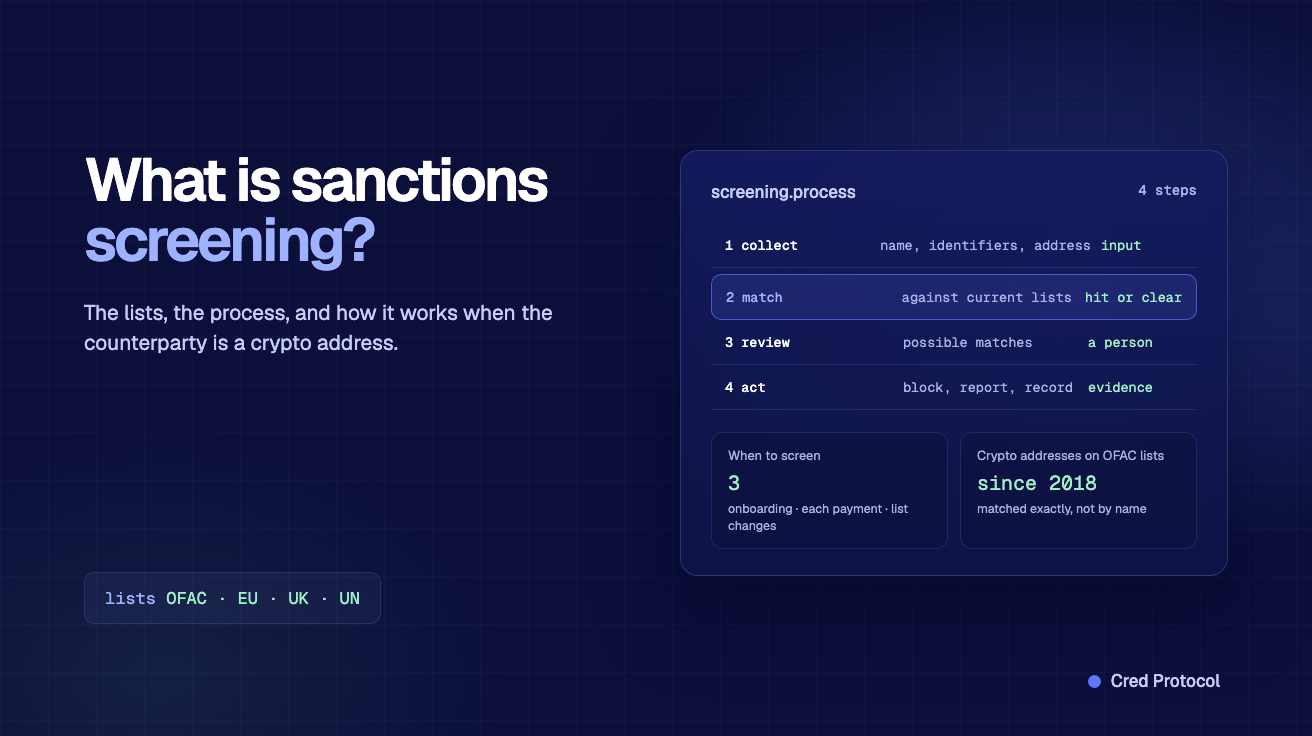
The Sanctions Screening Process
- Collect the data to screen. For a person or company: the legal name, any other names, and identifiers. For a payment: every party and address in it.
- Screen against current lists. Use the lists that apply to you, refreshed on a known schedule.
- Review possible matches. A person compares the hit with the list entry and decides whether it is the same party. Most name hits are not.
- Act on true matches. Depending on the list and your jurisdiction, that can mean refusing the transaction, blocking the property and reporting to the authority. This is the step where you want legal advice written down in advance.
- Record everything. Keep what was screened, when, against which list version, the result and who cleared it. A cleared false positive with no record looks the same as a missed match.
- Rescreen. Repeat when the lists change and at each transaction.
Real-Time Sanctions Screening
Batch screening checks a customer file overnight. Real-time sanctions screening checks a party at the moment of a transaction and returns an answer before the transaction completes. It became necessary as payments became instant: once funds settle in seconds and cannot be recalled, a check that runs after settlement only tells you about a violation that has already happened.
Real-time screening has two requirements batch screening does not. The check has to be fast enough to sit inside the payment flow, and the system needs a defined behaviour when the check cannot complete. A timeout is not a clear result, so the transaction should wait, retry or go to review.
Sanctions Screening for Crypto
Crypto transactions settle in seconds and cannot be reversed, so screening has to be real time by default. The other differences work in the screener's favour.
OFAC has published digital currency addresses on its lists since 2018, as identifiers attached to sanctioned parties. An address is an identifier, so the match is exact. Crypto sanctions screening at its most basic is a lookup with no fuzzy matching and no false positives from similar names. You can try one by hand in OFAC's own sanctions search tool.
The difficulty is elsewhere. Anyone can create a new address in a moment, so a sanctioned party is unlikely to pay you from the address on the list. OFAC's sanctions compliance guidance for the virtual currency industry points at this directly, noting that addresses which share a wallet with a listed address may carry sanctions risk even though they are not listed themselves. That is why crypto screening comes in depths:
- A list match checks the address itself.
- Direct exposure checks every address the wallet has transacted with, and the address that first funded it.
- Tracing and attribution follows funds through intermediaries and groups addresses into known entities.
Our comparison of crypto sanctions screening tools sorts five providers by those depths, including the free options for a list match.
Lending is a case worth naming. A lender makes the compliance decision before the credit decision, so sanctions screening is the first step of underwriting a wallet, ahead of any score. Our wallet screening guide sets out the order to run the checks in.
What Cred Protocol Covers, and What It Does Not
Cred Protocol is a credit data API for lenders, and it includes two sanctions checks for addresses.
- The screen endpoint matches one address exactly against OFAC's SDN and Consolidated lists and returns each matching entry. The lists refresh hourly. It accepts any digital-currency address format OFAC publishes.
- The exposure endpoint looks one hop out on EVM chains: the wallet's counterparties and its first funder. Our sanctions screening article walks through both.
The limits matter as much. Cred screens addresses, not names, so it does not replace name screening of customers. It covers OFAC lists only, not EU, UK or UN lists. It does not apply the 50 Percent Rule, trace funds beyond one hop or attribute addresses to entities, and it has no case management. A regulated institution needs a fuller product beside it.
What Screening Does Not Do
- It does not identify your customer. A screen compares what you were told, or the address you were given, with a list. Whether the customer is who they say is a separate check.
- It does not detect suspicious behaviour. A party can be absent from every list and still be laundering money. That is the job of transaction monitoring.
- It does not decide what to do with a hit. Blocking, rejecting and reporting are legal obligations that differ by list and by jurisdiction.
This article explains how sanctions screening works. It is not legal advice, and your obligations depend on your business and where it operates.
Next Steps
If your counterparties arrive as wallet addresses, create an API key and run a screen on an address you know. The quickstart covers the first request.