

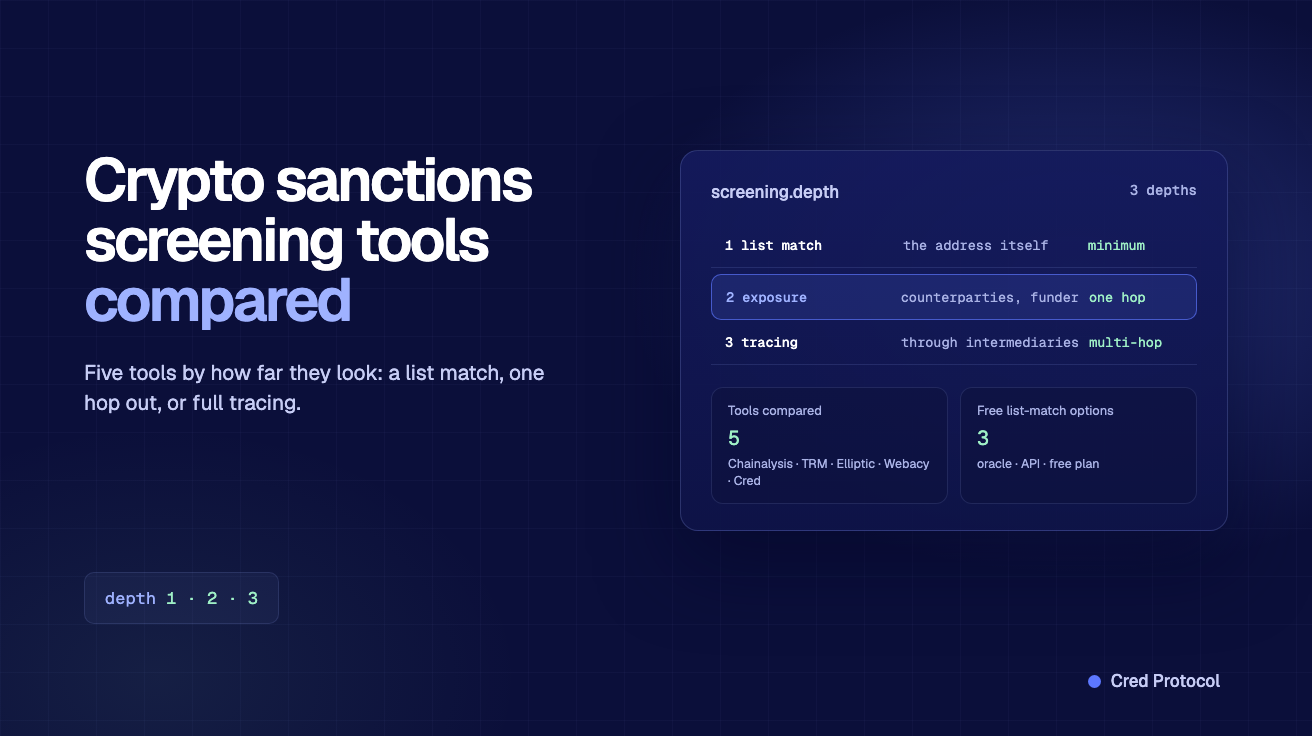
Three Depths of Screening
Every crypto sanctions screening tool, whether it is sold as wallet screening, crypto address screening or transaction monitoring, answers the same first question: is this address on a sanctions list? They differ in what they do after that. The useful way to compare them is by how far from the address they look.
| Depth | What it checks | What it catches |
|---|---|---|
| 1. List match | The address itself against published sanctions lists | Dealing directly with a designated address |
| 2. Direct exposure | Every address the wallet has transacted with, and who funded it | A wallet funded by, or paying, a designated address |
| 3. Tracing and attribution | Funds followed through intermediaries, bridges and exchanges, with addresses grouped into known entities | Laundered proceeds several steps removed, and addresses that belong to a sanctioned party but are not on any list |
Depth three is a different kind of product from the first two. It depends on a proprietary database that attributes addresses to real-world entities, built by investigators over years. That is what the large blockchain analytics firms sell, and it is why their products are priced and sold as enterprise compliance software.
Regulators expect more than depth one from businesses in scope. OFAC's 2021 guidance for the virtual currency industry recommends a risk-based compliance programme, and notes that unlisted addresses sharing a wallet with a listed one may also carry sanctions risk. Law firm summaries such as Skadden's set out the detail. How much depth your business needs is a question for your counsel, and it is the first thing to settle before choosing a tool.
A disclosure: Cred Protocol publishes this article and is one of the tools in it. Statements about other companies come from their own pages and documentation or from press coverage, linked beside each. Vendor figures are the vendors' own, and we have not tested the other products.
The Tools at a Glance
| Tool | Depth | What it is | Access |
|---|---|---|---|
| Chainalysis | 1 free, 3 paid | Blockchain analytics and compliance platform, with free sanctions tools launched in 2022 | Free oracle and API for the list match; paid products by contract |
| TRM Labs | 1 free, 3 paid | Blockchain intelligence platform, with a free sanctions screening API | Free API; wallet screening product by contract |
| Elliptic | 3 | Blockchain analytics platform; Lens is its wallet screening product | By contract |
| Webacy | 2, within a broader threat score | Wallet, token and transaction risk scoring | API key through a developer portal, or pay per request over x402 |
| Cred Protocol | 1 and 2 | OFAC screening and one-hop exposure, alongside wallet credit data | Self-serve API key, or pay per request with no account |
Chainalysis
Chainalysis is the best-known blockchain analytics firm, and its paid compliance products are built on the kind of entity attribution that depth three requires.
For a basic list match it also released two free tools in March 2022, as The Block reported: an on-chain oracle and an API using the same data. The oracle is a smart contract that says whether an address appears on a sanctions designation, usable by anyone without a customer relationship. According to Decrypt's coverage, the data comes from sanctions lists published by the United States, the European Union and the United Nations.
The oracle is the one tool here that a smart contract can call directly, which makes it the natural choice for a protocol that wants to refuse sanctioned addresses on-chain with no backend. Chainalysis described both free tools as basic checks and its paid products as the fuller offering. They launched some time ago, so confirm current availability and coverage before depending on them.
TRM Labs
TRM Labs is a blockchain intelligence firm serving compliance teams, investigators and government agencies. Like Chainalysis, its core product is attribution and tracing.
TRM also offers a free sanctions screening API, launched in March 2022. Its documentation describes an endpoint that takes one or more addresses and returns whether each has sanctions exposure, with a higher rate limit for users who request a free API key. TRM's own materials give different chain counts at different times, from 25 blockchains at launch to a much larger figure more recently, so check the current number.
Its paid wallet screening product is described by TRM as surfacing both direct and indirect exposure to sanctioned wallets across chains.
Elliptic
Elliptic is the third of the established analytics firms. Its wallet screening product, Lens, is described by Elliptic as covering any cryptoasset with a tradable value and tracing through bridges, decentralised exchanges and coin swaps, following funds through as many hops as needed. Its wallet screening page cites coverage of more than 65 blockchains and 250 bridges.
We found no free tier comparable to the Chainalysis and TRM list-match tools. Elliptic is a depth-three product sold to compliance teams.
Webacy
Webacy approaches the problem from wallet safety. It scores how risky a wallet, token or transaction is to deal with, from 0 to 100 where higher is riskier, and sanctions exposure is one of the inputs alongside mixers, hacks, scam reports and drainer activity. Its documentation lists fourteen chains, including non-EVM ones such as Solana and Sui, and it says plainly that it is not a KYC provider.
The result is a single threat score with the issues behind it, which suits a wallet or trading app that wants one number for "is this address safe to interact with". If you need the sanctions answer on its own, as a yes or no with the list entry, check how the response separates it. Our Cred Protocol vs Webacy page has more.
Cred Protocol
Cred Protocol is a credit data API for lenders, and sanctions screening is part of it because a lender has to make the compliance decision before the credit decision. It offers two calls.
- Screen checks one address against OFAC's Specially Designated Nationals list and its Consolidated list and returns every matching entry: the party's name, type, sanctions programmes and a link to the OFAC record. It accepts any digital-currency address OFAC publishes, not only Ethereum ones. It costs 1 Cred Unit.
- Exposure goes one hop out. It reads every native, internal and ERC-20 transfer the wallet has made, screens every counterparty and the address that first funded the wallet, and returns a risk level with the listed counterparties and how recent the contact was. It covers EVM chains, up to five per call, for 3 Cred Units.
The lists refresh hourly, matching is exact, and the response reports how much of a busy wallet's history was read. Both calls work with a self-serve API key or per request over x402 with no account. Our sanctions screening article walks through both.
The limits are as important as the features. Cred Protocol checks OFAC lists only, not EU, UK or UN lists. It looks one hop, and does not trace funds through intermediaries. It does not attribute addresses to entities, and it has no case management or alert workflow. It is not a substitute for a depth-three product where one is required.
Wallet Risk Scoring Tools Versus Sanctions Screening
Buyers often search for these products as crypto wallet risk scoring tools or wallet risk intelligence providers, and the five tools above all appear under those names. A risk score and a sanctions screen are different outputs, and it helps to know which one a tool returns.
| Output | What you get | Who it suits |
|---|---|---|
| Sanctions screen | A yes or no against named lists, with the list entry | Anyone who has to show a specific legal check was run |
| Wallet risk score | One number or level that blends sanctions exposure with other signals such as mixers, hacks and scam reports | Products that need a single decision per address, and compliance teams ranking alerts |
| Credit score | A measure of how likely the wallet is to repay, from its borrowing history and behaviour | Lenders setting terms |
Three questions sort wallet risk scoring tools quickly:
- Can you get the sanctions answer separately from the score? A blended score of 40 does not tell an auditor whether the address was on a list. Compliance teams generally need both the score and the underlying hit.
- Does the tool explain the score? A risk level with the indicators behind it can be reviewed and challenged. A bare number cannot.
- Is it a one-off check or continuous monitoring? Screening an address at onboarding and monitoring its transactions afterwards are separate jobs, and usually separate products. A regulated business comparing crypto transaction monitoring platforms is shopping at depth three, among Chainalysis, TRM Labs and Elliptic.
Of the tools here, Webacy is the one built around a single wallet risk score. Cred Protocol keeps the outputs apart: a sanctions screen, an exposure risk level with the counterparties behind it, and a credit score as a separate call. It does not produce a blended threat score.
The Free Options
If all you need is the list match, three of these cost nothing or close to it.
| Tool | Form | Good for |
|---|---|---|
| Chainalysis oracle | Smart contract | Checking inside a contract, with no backend |
| Chainalysis or TRM API | REST API | A backend check before accepting a deposit or connecting a wallet |
| Cred Protocol screen | REST API or MCP tool, free plan of 1,000 Cred Units a month | The list match with the OFAC entry returned, alongside credit data |
A list match alone is the minimum. It tells you nothing about a wallet that was funded from a designated address an hour ago.
Which Kind of Business Needs Which
- A regulated exchange, custodian or payments company. You need depth three, with attribution, tracing, monitoring and an audit trail. That means Chainalysis, TRM Labs or Elliptic, chosen through a proper procurement process. Nothing else in this article replaces them.
- A DeFi protocol that wants to block designated addresses on-chain. An on-chain oracle is the direct fit.
- A front end or wallet deciding whether to connect an address. A free list-match API covers the minimum. A threat score such as Webacy's adds scams and drainers, which are a more frequent danger to users than sanctions.
- A lender or credit protocol. You need the list match and direct exposure before you set terms, and you will be pulling credit data on the same address anyway. One API for both is simpler, and this is the case Cred Protocol is built for. Larger or regulated lenders will still want a depth-three tool beside it.
- A seller taking payments from AI agents. The check has to run in the moment before a payment settles. Know Your Agent screens the agent's owner and its wallet in one call.
Questions to Ask Any Vendor
- Which lists, and how often are they refreshed? OFAC only, or EU, UK and UN as well? Hourly, daily, or on a schedule nobody can state?
- What happens when an address is delisted? Designations are lifted as well as added, and a tool that keeps flagging a delisted address creates false positives you will have to explain.
- How deep does it look, and does it say how much it read? For exposure checks, ask whether internal transactions are included, since withdrawals from mixing contracts arrive that way, and whether the response reports partial coverage for very active wallets.
- Is matching exact or heuristic? Attribution finds addresses that are not on any list, at the cost of judgment calls. Exact matching has no false positives from inference and misses anything unlisted. Know which you are buying.
- Which chains, for which check? A list match is chain-independent. Exposure and tracing are not.
- What evidence do you get? For an audit you want the list entry, the date checked and the data version, not only a yes or no.
- What does it cost at your volume? Per-call pricing and enterprise contracts scale very differently.
What No Tool Does for You
A screening tool supplies an answer about an address. It does not decide your obligations, your risk appetite or what to do with a hit. Whether to block, report or review is a legal question that depends on your business and jurisdiction, and this article is not legal advice.
Screening is also only one of the checks worth running on a counterparty. Our wallet screening guide covers the others and the order to run them in.
Try the One-Hop Check
To see what a direct exposure check returns, create an API key and call the exposure endpoint on an address you know. The screen endpoint reference documents every field in the list match.