

The Question Every Lender Has to Ask First
Before a credit decision there is a compliance decision. Is this address on a sanctions list? Has it dealt with one? Who funded it? In traditional finance those checks are routine, slow and outsourced. On-chain, the data to answer them is public, but the answer still has to be assembled: the US Treasury publishes its lists as XML, addresses arrive in a dozen formats, and "has it dealt with one" means reading every transfer a wallet has ever made.
Cred Protocol now does that assembly for you, in three layers that build on each other. Each is a single API call, and all three run on the same copy of the lists, refreshed every hour from OFAC's publication stream.
Layer One: Is This Address Listed?
Screen Address checks one address against the OFAC Specially Designated Nationals list and the Consolidated non-SDN list, and returns every active entry that matches: the sanctioned party's name, its type, the sanctions programs it falls under, and a deep link to the OFAC entry.
curl https://api.credprotocol.com/api/v2/sanctions/screen/0x3e37627dEAA754090fBFbb8bd226c1CE66D255e9 -H "Authorization: Bearer YOUR_API_KEY"{
"address": "0x3e37627dEAA754090fBFbb8bd226c1CE66D255e9",
"sanctioned": true,
"lists_checked": ["ofac_sdn", "ofac_consolidated"],
"matches": [
{
"source": "ofac_sdn",
"entity_name": "LAZARUS GROUP",
"entity_type": "Entity",
"programs": "DPRK3",
"symbol": "ETH",
"currency_name": "Ethereum",
"address": "0x3e37627dEAA754090fBFbb8bd226c1CE66D255e9",
"source_url": "https://sanctionssearch.ofac.treas.gov/Details.aspx?id=..."
}
]
}Three details matter in practice. Any digital-currency address OFAC publishes is accepted, not only Ethereum: Bitcoin, Litecoin, Monero, Tron, XRP and the rest, with ENS names resolved first. Matching is exact on the address and ignores case, so a checksummed and a lowercased copy of the same address give the same answer. And delisted addresses are never reported as sanctioned: when a designation is lifted, as Tornado Cash's was in 2025, the next hourly refresh drops it. The call costs 1 Cred Unit.
Layer Two: Has It Dealt With One?
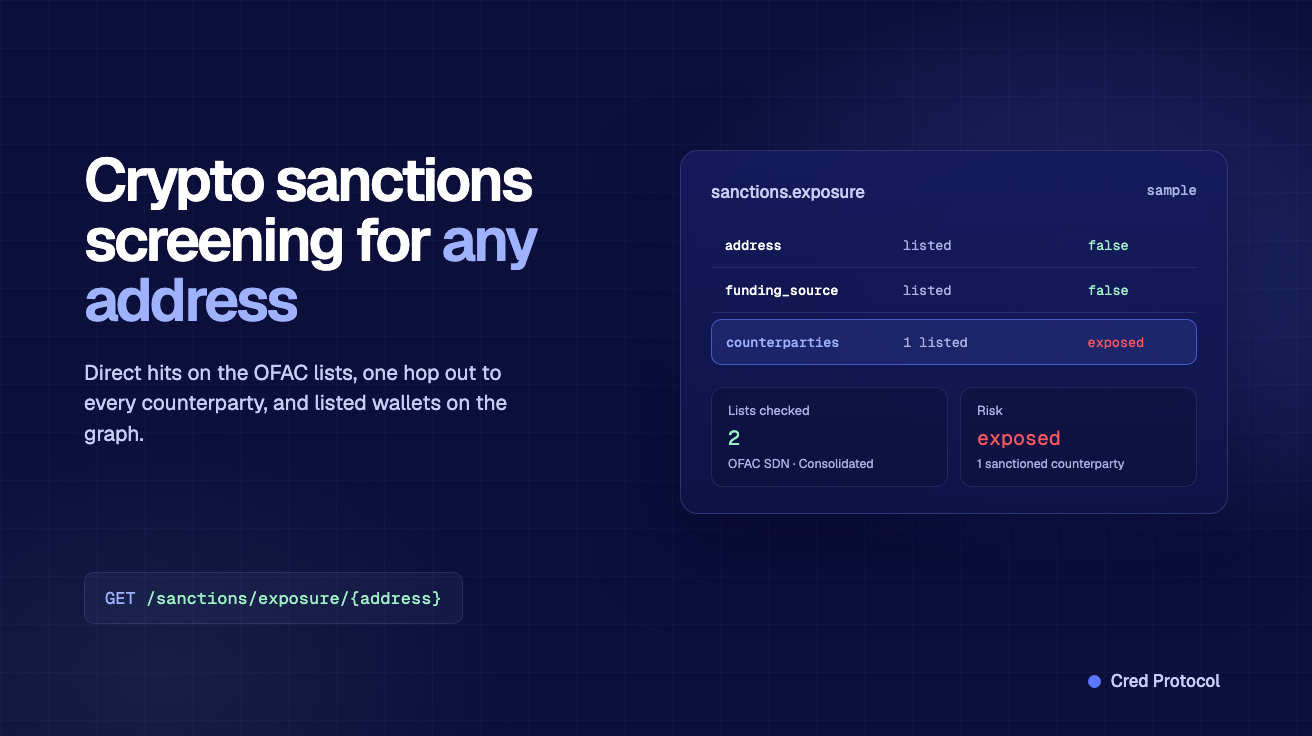
A clean screen is not a clean wallet. The address that worries a compliance officer is rarely on the list itself; it is the one that received its first deposit from a mixer, or that sends a few hundred dollars a month to an address that is. Sanctions Exposure goes one hop out.
It reads every native, internal and ERC-20 transfer a wallet has made, in either direction, collects every counterparty and the address that first sent the wallet value, and screens all of them in one pass. The response says what it found and how bad it is:
risk:sanctionedif the address itself is listed,funded_by_sanctionedif its first funds came from a listed address,exposedif it has transacted with one, ornone. The levels are ordered, so the worst applies.funding_source: the first address that sent the wallet value, when, in which transaction, and whether it is listed.exposure.sanctioned_counterparties: every listed address the wallet has dealt with, with direction, transaction count, first and last contact, and whether the contact is recent (inside 90 days).coverage: whether the whole history was read. For a very busy wallet the oldest transfers may fall outside what one query returns, and the response says so rather than pretending.
Internal transactions are the reason the funding check works. A Tornado Cash withdrawal does not arrive as a normal transfer; it reaches the recipient as an internal transaction from the pool contract. A check that only read ordinary transactions would miss exactly the case it exists to catch. Ethereum is read by default, and the chains parameter widens the read to up to five chains for the same 3 Cred Units.
import httpx

r = httpx.get(
    "https://api.credprotocol.com/api/v2/sanctions/exposure/0xYourCounterparty",
    params={"chains": "1,8453"},
    headers={"Authorization": "Bearer YOUR_API_KEY"},
)
exposure = r.json()
if exposure["risk"] != "none":
    hits = exposure["exposure"]["sanctioned_counterparties"]
    print(exposure["risk"], [h["address"] for h in hits])
Layer Three: See It
The transaction graph has always shown a wallet's ERC-20 transfer network as nodes and edges. It now screens every wallet node against the same lists. A listed wallet carries sanctioned: true and its list entries in sanctions, and the response counts them in sanctioned_wallets, so any graph you render can highlight them.
Ours does. In the developer console, a wallet on an OFAC list is drawn in red, whether it is the address you asked about or one of its counterparties. It stays red while you hover other parts of the network, the statistics panel counts the listed wallets, an alert under the canvas says how many there are, and a right-click on a red node shows who it is, which list, which programs, and a link to the OFAC entry. A path from a wallet to a listed address through a token is something you can now see rather than infer.
The transfers behind the graph are cached for ten minutes. The list match is not cached at all, on the graph or on either endpoint, so a designation published this morning shows in every response within the hour.
For Agents
All three are tools on the Cred MCP server: screen_sanctions, screen_sanctions_exposure and get_transaction_graph. An agent deciding whether to transact with a counterparty can screen it, screen its history and pull its network in the same conversation as its credit score, and the agent skill tells it which tool answers which question.
What It Does Not Do
- Only OFAC, for now. The SDN and Consolidated lists are the ones we ingest. EU, UK and other national lists are not yet included.
- One hop. Exposure screens direct counterparties and the funding source. It does not trace funds through intermediaries, and it does not cluster addresses into entities.
- Exact matching. An address is listed or it is not. There is no fuzzy or heuristic matching, which also means no false positives from it.
- The score is unchanged. None of this feeds the Cred Score. A sanctions check is a gate, not a factor, and you decide what to do with the answer.
Try It
Both endpoints are available now to every API key and accept x402 payments for accountless use. The reference pages document every field. If you do not have an API key yet, create one in the console and open the transaction graph with an address you want to look at.