

Four Products Under One Name
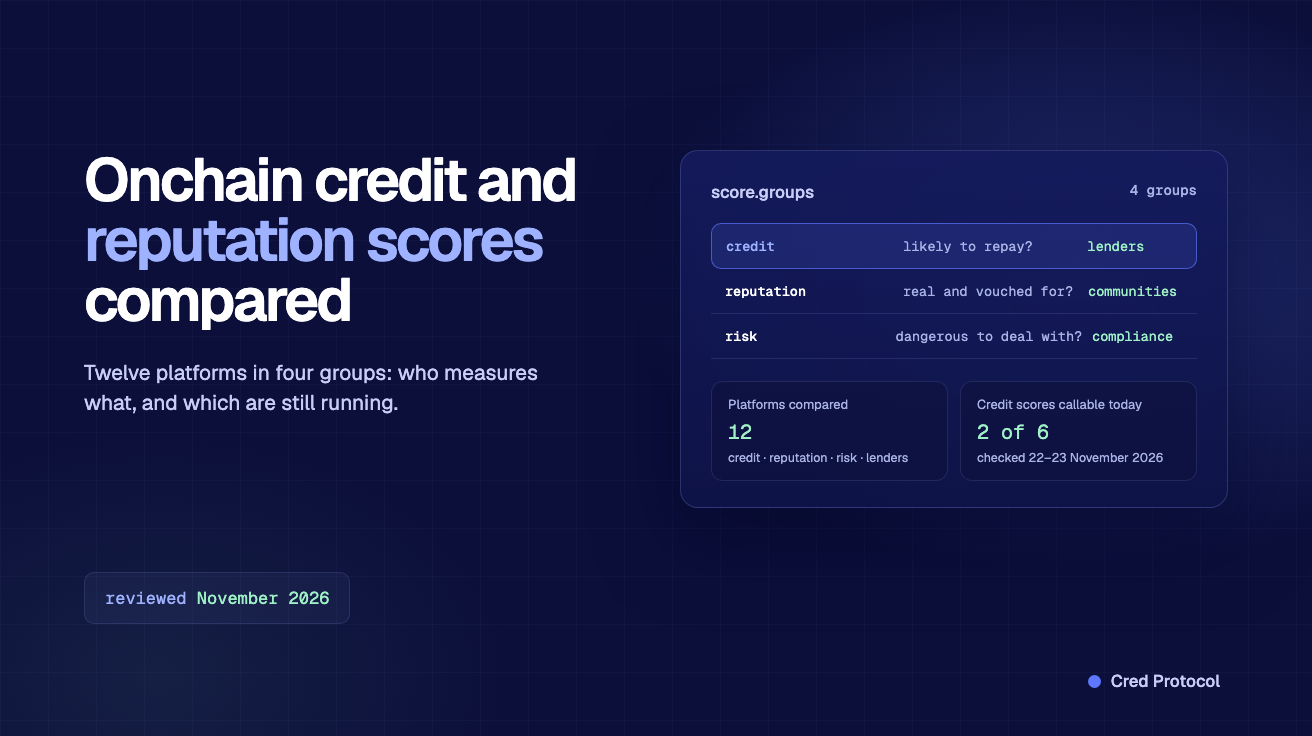
Search for a wallet score and you will find a dozen companies that appear to do the same thing. They do not. The products sort into four groups, and each group answers a different question about an address.
| Group | The question it answers | Who asks it |
|---|---|---|
| Credit score | Is this wallet likely to repay? | Lenders setting terms |
| Reputation or identity score | Is this a real, established participant others vouch for? | Communities, airdrops, marketplaces |
| Risk or threat score | Is this wallet dangerous to deal with? | Exchanges, wallets, compliance teams |
| Lender that underwrites | Will we lend to this borrower ourselves? | The lender's own credit team |
Most confusion in this market comes from comparing products across groups. A reputation score is not a weak credit score, and a threat score says nothing about repayment. The useful comparison is within a group, after you know which question you are asking.
A disclosure before the detail: Cred Protocol publishes this article and is one of the platforms in it. Statements about other companies come from their own pages or from the public sources linked on our comparison pages, checked on 22 and 23 November 2026. Where we could not confirm something, we say so.
The Platforms at a Glance
| Platform | Group | What you get back | Status when checked |
|---|---|---|---|
| Cred Protocol | Credit score | Score from 300 to 1000 with factor ratings, a report and webhooks | Live |
| ChainAware | Credit score, fraud-weighted | Borrower risk score from 0 to 100 and a grade from A to F | Live |
| Blockchain Bureau (Providence) | Credit score | A wallet credit score with flow of funds and AML checks | Site and API offline |
| Spectral Finance | Credit score | MACRO Score from 300 to 850 | Company moved to AI agents |
| RociFi | Credit score and lending pools | Minted score from 1 to 10 | Merged into Gora in 2024 |
| Masa Finance | Credit score | Soulbound credit score token | Winding down |
| Nomis | Reputation score | Wallet reputation score | Not checked |
| Ethos | Reputation score | Credibility score from vouches and reviews | Not checked |
| Human Passport | Identity score | Humanity score built from verified stamps | Not checked |
| Webacy | Risk score | Risk score from 0 to 100, higher is riskier | Live |
| Maple Finance | Lender | A credit decision and loan terms | Live |
| TrueFi | Lender | A credit decision and loan terms | Now Brila |
"Not checked" means we describe what the product is from public sources but did not verify its current status the way we did for the nine platforms on our comparison pages.
Credit Scores
A credit score predicts repayment. Its main input is a wallet's lending record: what it borrowed, whether it repaid, and whether it was liquidated. Six platforms have built one. Two can be called today.
Cred Protocol
Cred Protocol scores any EVM wallet from 300 to 1000 from its borrowing, repayment and liquidation record on Aave, Compound and Morpho Blue, together with how the wallet behaves across ten chains. Lending events are read on Ethereum and Base. The response includes a range from Low to Excellent, a decile and six factor ratings that explain the number. The same data is available as a full credit report and as webhooks on wallets a lender is watching.
Nothing is required of the borrower: a lender scores any address, and nothing is minted. Access is by API key, with a free plan of 1,000 Cred Units a month, or per request over x402 or MPP with no account. A score costs one Cred Unit.
ChainAware
ChainAware sells wallet fraud prediction and behavioural analytics, with a credit score among its products. Its Lending Risk Assessor returns a borrower risk score from 0 to 100 and a grade from A to F. By ChainAware's own description, that grade is 40% fraud probability, 20% credit score, 25% onchain experience and 15% behavioural profile.
That weighting is the real difference between the two live options. ChainAware's borrower grade is led by predicted fraud. Cred Protocol's score is a credit model first, with sanctions screening and sybil analysis as separate calls. ChainAware also lists Solana, TON and Tron among the chains for its assessor, which EVM-only scores do not cover; its own comparison article says the credit score input covers Ethereum only. Cred Protocol vs ChainAware has the full table.
Blockchain Bureau and Providence
Blockchain Bureau built Providence, a wallet credit score sold on the scale of its dataset: by its own count in March 2026, 17 blockchains including Bitcoin and other non-EVM chains, and 15 million recorded loans. When we checked, its website and API hosts returned an error, and we found no closure announcement. If you are evaluating it, confirm you can reach the service first. Details and sources.
Spectral Finance
Spectral built the MACRO Score, a 300 to 850 score for Ethereum wallets pitched as an onchain equivalent of a FICO score, and raised about $30 million. From late 2023 the company turned to onchain AI agents. When we checked, the MACRO app and docs did not resolve, and we found no formal retirement notice. Details and sources.
RociFi
RociFi ran under-collateralized lending pools on Polygon and later zkSync, gated by a credit score the borrower minted as a token, from 1 to 10. In March 2024 it announced a merger with the oracle network Gora. The announcement did not say what would happen to the score or the pools. Details and sources.
Masa Finance
Masa set out in 2022 to build a decentralized credit bureau: a soulbound identity with a credit score token combining onchain history with offchain data the user chose to connect. Its first credit score token, on Celo's testnet, was powered by Cred Protocol's score. Masa moved to an AI data network in 2024, and in March 2026 its announcement channel said the company was preparing to wind down. Details and sources.
Reputation and Identity Scores
A reputation score measures standing, not repayment. It asks whether a wallet is an established participant, whether it is a unique person, or whether other people vouch for it. These are the right tools for airdrop eligibility, community access and marketplace trust. They are not designed to price a loan, and none of the three below presents itself as a credit score.
- Nomis describes itself as an onchain identity protocol that assigns reputation scores to wallets from their activity, such as wallet age and transaction history, which users can mint as a token.
- Ethos builds a credibility score from what other people say: reviews and staked vouches from other users, with a mechanism for penalising bad actors, as Decrypt described it. It is social reputation, recorded onchain.
- Human Passport, formerly Gitcoin Passport, combines verified credentials called stamps into a score for how likely a wallet is to be a unique human. It is a sybil-resistance tool.
The groups are complementary. Cred Protocol's identity endpoint reads a wallet's Passport score and stamps, and attestations are one of the inputs to the Cred score. A lender offering reduced collateral needs both answers: that the borrower is one person and not a farm of wallets, and that the person repays.
How to tell the two apart
| Credit score | Reputation score | |
|---|---|---|
| Main input | Borrowing, repayment and liquidation | Activity, credentials, or other people's vouches |
| Predicts | Repayment | Authenticity and standing |
| Typical decision | Collateral ratio, credit limit, rate | Access, eligibility, rewards |
| Who starts it | Usually the lender, about any address | Often the user, who mints or builds a profile |
Risk and Threat Scores
Webacy scores how risky a wallet, token or transaction is to deal with, from 0 to 100 where higher is riskier, drawing on sanctions lists, scam and drainer activity, exploits and fund flows across fourteen chains. It is a threat and compliance score: nothing we read from Webacy describes it as a measure of creditworthiness.
The distinction from credit is direction. A threat score looks for reasons a wallet is dangerous. A credit score looks for evidence that it repays. A wallet can be perfectly safe to transact with and still a poor borrower, and the reverse. Cred Protocol vs Webacy sets the two side by side, and our wallet screening guide covers where each check belongs.
Lenders That Underwrite Their Own Borrowers
Two names appear in most lists of onchain credit platforms without being scores at all.
Maple Finance is a lender and asset manager. It underwrites its own institutional borrowers after KYC, KYB and a credit review, and its business today is overcollateralized lending, a change from the uncollateralized pools it ran until borrower defaults in 2022. It does not publish a score. Details and sources.
TrueFi launched in 2020 as a protocol for uncollateralized loans to institutions and declared its first default in October 2022. A governance proposal executed in March 2026 moved it to a new structure called Brila. It was never a score other lenders could call. Details and sources.
If you want yield from institutional borrowers, these are the category to look at. If you are a lender who needs to assess your own borrowers, they are not something you can integrate.
What the Field's History Shows
Of the six credit scores above, four are no longer offered in the form they launched in. Three patterns run through that history, and they are useful when evaluating anything in this market.
- Scores the borrower had to mint did not last. RociFi's and Masa's scores were tokens the borrower created. That limits a score to borrowers who opt in, and a lender cannot assess someone who has not. The products that remain score any address.
- A score tied to one lender's pools shares that lender's fate. A score sold as infrastructure to many lenders does not depend on any single pool surviving.
- Check that it answers. Several of these products have no retirement notice; they simply stopped responding. Before planning around any provider, including us, call the API and read the date on its last model release.
How to Choose
- Name the decision. Setting loan terms needs a credit score. Gating an airdrop needs a reputation or identity score. Screening deposits needs a threat score. Many products need two of these, in sequence.
- Check who has to act. If your users are borrowers who arrive as addresses, you need a score that works on any address without the borrower minting or connecting anything.
- Check the chains, separately for each input. Wallet activity and lending events are often covered on different sets of chains. Ask which chains feed the part of the score you care about.
- Ask what the score is made of. You do not need the formula, and a provider that publishes exact weights invites gaming. You do need to know whether repayment history or something else leads it.
- Ask what happens when data is missing. A provider should tell you when it could not read part of a wallet's history, not return a confident number built on a gap.
- Ask what you may use it for. Cred Protocol's default delivery is commercial analytics and is not a consumer report; decisions about an individual's eligibility for credit need its certified consumer-report mode. Ask every provider the same question.
Go Deeper
The comparison hub has a page for every pairing of the nine platforms we verified, each with its sources and the date it was checked. For how the Cred score itself works, see the credit scoring API guide. To judge the output for yourself, create an API key and score a wallet you already know well.