

What Agentic Payments Are
An agentic payment is a payment made by an AI agent acting on its own. No person types a card number or clicks a button at the moment of purchase. The agent decides that it needs something, finds the price, pays and carries on with its task.
Two quite different things share the name, and most confusion about the topic comes from mixing them.
| Agent shopping for a person | Machine paying a machine | |
|---|---|---|
| Example | An assistant books a flight or reorders groceries | An agent buys an API call, a dataset or compute |
| Who is the customer | A human, who delegated authority | The agent itself, or the business running it |
| Typical amount | Tens or hundreds of dollars | Fractions of a cent to a few dollars |
| Frequency | Occasional | Thousands of times a day |
| Hard problem | Proving the human authorised this purchase | Making a tiny payment cheaper than the thing it buys |
| Usual rail | Cards, through tokens issued to the agent | Stablecoins, settled inside the HTTP request |
This guide covers both, with more detail on the second, which is where Cred Protocol operates: every paid endpoint of our API can be bought per request by an agent with no account.
Why Existing Payments Do Not Fit Agents
Online payments were designed around a person. An agent runs into that design at every step.
- Checkout pages. A payment form, a one-time code sent to a phone and a "confirm" button all assume eyes and hands.
- Accounts and API keys. Buying access to an API normally means signing up, choosing a plan and storing a key. An agent that discovers a useful service mid-task cannot do that, and should not have to.
- Minimum economics. Card fees make a one-cent purchase uneconomic. Subscriptions solve that for people and make no sense for a caller who needs one request.
- Fraud models. Card fraud systems look for human behaviour. An agent that makes two thousand purchases a minute from a data centre looks exactly like the thing they are built to stop.
The protocols below are attempts to remove these obstacles, each from a different starting point.
The Protocols
The descriptions here come from each project's own documentation or from the comparisons linked at the end of this section. The field is moving quickly, so check current status before building on any of them.
| Protocol | From | What it does | Best suited to |
|---|---|---|---|
| x402 | Coinbase | Stablecoin payment inside an HTTP request, using the 402 status code | Machine-to-machine micropayments |
| MPP | Stripe and Tempo | A "Payment" HTTP authentication scheme: challenge, credential, receipt | Machine-to-machine payments across several methods |
| AP2 | Signed mandates that record what an agent is permitted to buy | Proving a human authorised a purchase | |
| ACP | OpenAI and Stripe | A checkout protocol with delegated payment tokens | Agents buying from merchants for a person |
| Card network programmes | Visa and Mastercard | Card-like tokens issued to agents on the existing networks | Agent purchases at merchants that take cards |
x402
HTTP has had a status code for "payment required" since the 1990s: 402. It was reserved and never given a standard meaning. x402 gives it one. A server answers an unpaid request with 402 and a machine-readable description of what to pay. The client signs a stablecoin transfer, repeats the request with the payment attached, and gets the response. One round trip, no account.
MPP, the Machine Payments Protocol
MPP, co-authored by Stripe and Tempo, also builds on 402 and frames payment as HTTP authentication. The server lists one or more challenges, the client fulfils one and returns a credential, and the server answers with a receipt. Because a challenge names a method, one endpoint can offer several ways to pay. Stripe's documentation covers its side of it.
AP2, the Agent Payments Protocol
Google's AP2 addresses authorisation more than settlement. Its core idea is the mandate: a cryptographically signed record of what an agent has been permitted to do, so that a merchant and a payment provider can verify that a purchase falls within what the user approved.
ACP, the Agentic Commerce Protocol
ACP, developed by OpenAI and Stripe and open-sourced in 2025, handles merchant checkout for agents. It lets a user delegate payment credentials to an agent through tokens, so the agent never holds the raw card details.
Visa and Mastercard
Both card networks have announced programmes, Visa Intelligent Commerce and Mastercard Agent Pay, that issue card-like tokens to agents so they can pay over the existing networks with the networks' fraud and dispute systems behind them.
These are layers more than rivals. Commentators such as Fireblocks describe a stack: a commerce layer for checkout, a trust layer for mandates, and a settlement layer for moving the money. A merchant serving many kinds of agent may end up supporting more than one.
How a Pay-Per-Request Payment Works
The machine-to-machine flow is easiest to understand from a real exchange. Call a paid Cred Protocol endpoint with no credentials:
curl -i https://api.credprotocol.com/api/v2/score/address/vitalik.ethThe answer is a 402 that says what the call costs and how to pay for it. Abridged:
{
  "detail": {
    "error": "authentication_required",
    "cred_units": 1,
    "options": [
      { "method": "api_token", "header": "Authorization: Bearer YOUR_API_KEY" },
      { "method": "x402_payment", "header": "X-PAYMENT: <signed_payment>", "price": "$0.01", "currency": "USDC" },
      { "method": "mpp", "header": "Authorization: Payment <credential>", "price": "$0.01" }
    ]
  }
}
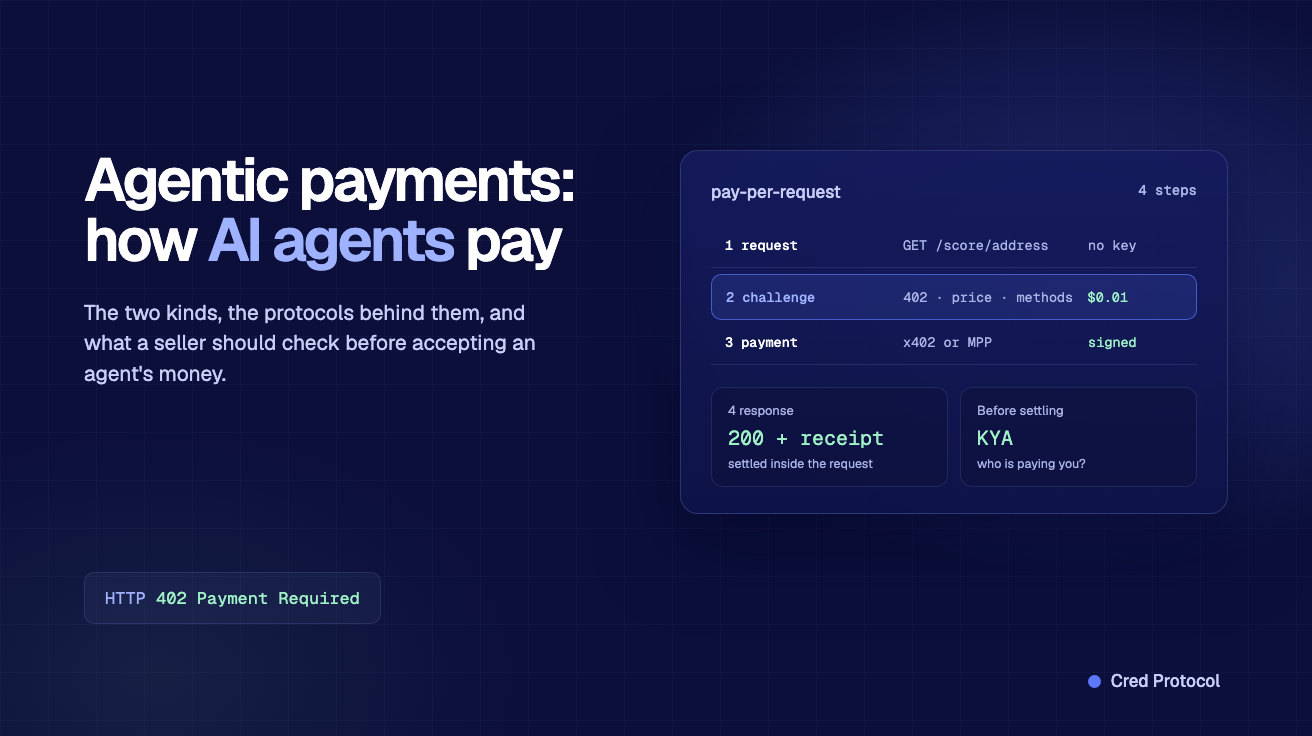
The agent picks a rail it supports, attaches the payment and repeats the request. The response is the data, with a receipt in the headers. Four steps, all inside ordinary HTTP:
- Request. The agent calls the endpoint.
- Challenge. The server answers 402 with the price and the accepted methods.
- Payment. The agent signs a payment and retries with it attached.
- Response and receipt. The server verifies and settles the payment, returns the data and a receipt.
The body of the 402 is written to be read by a language model as well as by a payment library, so an agent that has never seen the API can work out what to do. You can watch the exchange step by step on our interactive demo.
If You Sell to Agents
Accepting the payment is the simple part. The harder questions are the ones a human checkout used to answer implicitly.
Who is paying you?
With pay-per-request, you learn who the customer is only when the payment arrives, and all you learn is a wallet address. Before you settle it, you may need to know whether that wallet is on a sanctions list, whether it belongs to a registered agent, and who controls it. This is the job of a Know Your Agent check, which runs in the moment between verifying a payment and settling it, so a refused payer's funds never move.
What is the unit of sale?
Per-request pricing forces a decision subscriptions let you avoid: what one call is worth. Price by the cost and value of the call, publish the prices, and keep them identical across payment methods. We price every endpoint in Cred Units at one cent each, whether the caller uses an API key, x402 or MPP.
What does the agent need to succeed?
- A self-describing refusal. The 402 should say the price, the methods and where the specification lives.
- More than one rail. Some agents hold stablecoins in a wallet; others cannot hold crypto at all.
- No charge for failures. Charge on success. An agent that pays for errors will stop calling.
- A receipt. Whoever runs the agent needs to reconcile what it spent.
Do you extend credit?
Requiring every agent to pre-fund a wallet shuts out agents with a good record and no float. One answer is to let reputation stand in for prepayment. Cred Protocol's own API does this through MPP: a wallet with a Cred Score of 640 or above can prove ownership with a signature, receive credit for the session, and settle afterwards. It is the same idea as a trade account, applied to software. Our post on agentic credit describes how it works.
If You Build Agents That Pay
- Give the agent a budget, not a blank cheque. Set limits per call, per task and per day, enforced outside the model. A prompt is not a spending control.
- Separate the wallet from the operator's treasury. Fund the agent's wallet with what it may spend and no more.
- Check the seller. Payment protocols move money; they do not tell you whether the service is honest. An agent can screen a counterparty's wallet before paying it, using the same checks a seller would run on the agent.
- Keep the receipts. Log every challenge, payment and receipt so a person can audit what the agent bought and why.
- Build a record. An agent that registers an identity and pays reliably accumulates a history that sellers can read. As more sellers price or gate by reputation, that history has value.
What Is Still Unsettled
- Liability. When an agent buys the wrong thing, or is manipulated into buying it, who bears the loss: the user, the developer, the merchant or the payment provider? Mandates and tokens create evidence, and the rules that use that evidence are still being written.
- Interoperability. There is no single standard. Sellers who want to serve every agent may need to support several protocols for some time.
- Identity. A wallet address is not an identity. Registries for agents exist and are young, and most agents paying today are not registered anywhere.
- Compliance. Sanctions and anti-money-laundering obligations do not disappear because the customer is software. How they apply to a one-cent payment from an unknown wallet is a question for your counsel.
Where to Start
If you want to see agentic payments from the buyer's side, call any paid endpoint of our API without credentials and read the 402 it returns. The payments guide documents every rail, with code for each.
If you sell over x402 and want to know who is paying you, the Know Your Agent documentation shows the one-line hook that screens each payer before settlement. Earlier posts cover the individual rails in more depth: x402 for pay-per-request APIs and MPP with Stripe and Tempo.