

What Wallet Screening Is
Wallet screening is checking a crypto address before you do business with it. A lending protocol screens a borrower's wallet before opening a credit line. An exchange or a payments company screens a deposit address before crediting it. A treasury team screens a counterparty before sending a payment.
The address is public and so is its history, which makes screening on-chain different from screening a bank customer. You do not ask the counterparty for anything. You read what the wallet has done and decide.
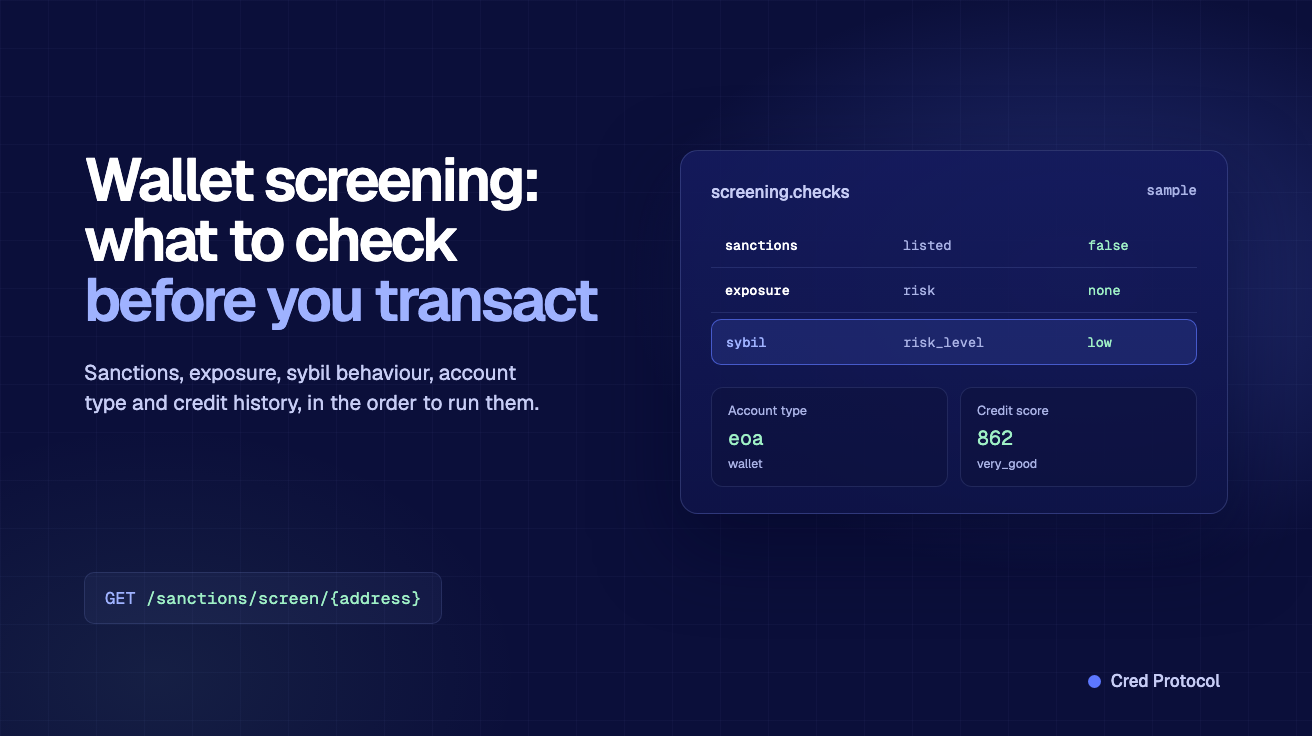
Most teams start with one check, usually a sanctions lookup, and stop there. That answers one question. A complete screen answers five, and they are worth separating because each has a different cost, a different failure mode and a different consequence.
The Five Checks
1. Is the address on a sanctions list?
This is the check with legal weight. The US Treasury's Office of Foreign Assets Control (OFAC) publishes digital-currency addresses belonging to sanctioned parties, and dealing with a listed address is generally prohibited for US persons and businesses.
The lookup itself is simple: the address is listed or it is not. The work is in keeping the lists current. Designations are added and removed, and a screen that runs on last month's copy is wrong in both directions. Ask any provider how often its lists refresh. Cred Protocol's sanctions screen refreshes hourly from OFAC's publications and matches on the exact address.
2. Has it dealt with a sanctioned address?
A clean result on the first check says little about a wallet that received its first deposit from a mixer. Exposure screening looks one step out: every address the wallet has sent value to or received value from, and the address that first funded it.
Two details decide whether an exposure check is worth having. It must read internal transactions, because withdrawals from mixing contracts arrive as internal transactions and are invisible to a check that reads only ordinary transfers. And it must say how much of the history it covered, because a very active wallet may have more transfers than one query returns. A sanctions exposure check that reports "no exposure" without reporting its coverage is giving you less than it appears to.
3. Is it a real participant or one of a farm?
Sybil detection asks whether an address behaves like an independent user or like one of many wallets run by a script. The signals are behavioural: few distinct counterparties, mechanical timing, minimal gas spending, no identity attestations.
This matters most where you give something per wallet: an airdrop, a signup bonus, a credit line, a free tier. It matters less for a one-off payment from a counterparty you already know. Cred's sybil detection returns a score from 0 to 100 with a risk level and the individual indicators behind it.
4. What kind of account is it?
An address can be a person's wallet, a smart wallet, a multisig controlled by several signers, a token contract, or another kind of contract entirely. The difference changes how to read everything else. A multisig's history describes an organisation's treasury, not an individual. A contract that is neither a wallet nor a multisig may not be able to do what you expect of a counterparty at all.
Cred's score and report responses carry the account type, so this check comes free with the next one.
5. How has it behaved with credit?
The first four checks look for reasons to refuse. The last one looks for reasons to offer better terms. A wallet's borrowing history is public: what it borrowed on Aave, Compound and Morpho, whether it repaid, and whether it was ever liquidated. A credit score condenses that history, with the wallet's age, holdings and activity, into one number.
If you lend, this is the check that sets terms. If you do not lend, it is still a useful measure of how established a counterparty is.
The Order to Run Them In
Run the cheap, decisive checks first and stop as soon as one refuses.
| Step | Check | Cost in Cred Units | Stop if |
|---|---|---|---|
| 1 | Sanctions screen | 1 | The address is listed |
| 2 | Credit score, with account type | 1 | The account type or score rules it out under your policy |
| 3 | Sanctions exposure | 3 | It was funded by a listed address, or your policy refuses exposure |
| 4 | Sybil detection | 3 | The risk level is above your threshold |
A sanctions screen is a single request:
curl https://api.credprotocol.com/api/v2/sanctions/screen/0xADDRESS \
  -H "Authorization: Bearer YOUR_API_KEY"
Every endpoint accepts an ENS name in place of an address. If the counterparty is an AI agent, one Know Your Agent call runs the sanctions and exposure checks on both of its wallets and adds the agent-specific ones.
Screening Once Is Not Enough
A screen describes a wallet at one moment. A borrower who was clean at origination can be liquidated elsewhere next week, and an address can be added to a sanctions list at any time.
There are two ways to keep the answer current. The first is to screen again at each significant action, which is cheap for sanctions and worth doing before every payout. The second is to be told when something changes. Monitoring webhooks notify your endpoint when a watched address borrows, repays, is liquidated, or when its credit score moves, so you rescreen in response to events instead of on a timer.
What Screening Cannot Tell You
- Who owns the wallet. Screening reads an address's history. It does not identify the person or company behind it. Where the law requires you to know your customer, wallet screening sits beside that process and does not replace it.
- Anything beyond the lists and hops it covers. Cred's sanctions checks cover OFAC's SDN and Consolidated lists and look one hop out. They do not trace funds through intermediaries or cluster addresses into entities. If you need multi-hop tracing, that is a different category of tool.
- What a fresh wallet will do. A new address has nothing to read. Treat "no history" as its own answer, with its own policy, and do not read it as a clean result.
- Whether you may make a credit decision about an individual. Cred's default delivery is commercial analytics and is not a consumer report. Using a score to decide an individual's eligibility for credit requires the certified consumer-report delivery mode.
This guide describes what the checks do. It is not legal advice, and your obligations depend on your business and jurisdiction.
Next Steps
The quickstart gets you from an API key to a first response in a few minutes, and the sandbox returns mock data for testing your integration. Create an API key to screen your first address.