

What Counterparty Risk Is
Counterparty risk is the risk that the other side of an agreement does not do what it owes you. A borrower does not repay. A trading venue cannot return your deposit. A desk takes your payment and does not deliver the asset.
It is usually split in two. Default risk is the chance that the counterparty fails over the life of the exposure. Settlement risk is the narrower chance that you deliver your side of a trade and they do not deliver theirs. Both come down to the same two questions: how much do they owe me, and how likely are they to be unable to pay?
Market risk is a different thing. If you hold an asset and its price falls, nobody failed you. Counterparty risk only exists where you depend on someone else's ability or willingness to perform.
Where Counterparty Risk Sits in Crypto
Self-custody and atomic settlement remove counterparty risk from simple transfers and swaps. It returns the moment you leave assets with someone or extend credit.
| Where | Who the counterparty is | What can go wrong |
|---|---|---|
| Trading platforms and exchanges | The platform, which holds your balance as its liability | The platform is insolvent, freezes withdrawals or has lent your assets out |
| Custodians | The custodian and whoever it sub-delegates to | Assets are not segregated, or are lost or encumbered |
| Lending and credit lines | The borrower | The borrower does not repay, or the collateral is worth less than the loan |
| OTC trades with deferred settlement | The trading desk or the other party | One side delivers and the other does not |
| DeFi lending pools | The pool's borrowers, collectively | Liquidations fail to cover debt and the pool is left with a shortfall |
| Pool-based perpetual exchanges | The traders, from a liquidity provider's side | In an LP-to-trader model the pool pays traders' profits, so a run of winning traders is the providers' loss |
The first two rows are the ones most people mean by counterparty risk in online trading platforms: your balance on screen is a claim on the company, and its value depends on the company's solvency.
Why It Is Hard to See, and Where It Is Not
In 2022 several large crypto lenders, a hedge fund and an exchange failed within months of one another. The losses moved through loans between them that outsiders could not see: who had lent to whom, against what collateral, and how often the same assets had been pledged. Creditors found out the size of their exposure after the fact.
That is the usual condition of counterparty risk. A company's liabilities sit in its own books, and you see them when it chooses to show you or when it fails.
On-chain activity is the exception. If a counterparty borrows on Aave, Compound or Morpho, every loan, repayment and liquidation is public the moment it happens, with the amount. You do not need the counterparty's cooperation to read it, and you can read it continuously. It is a partial view, as the limits section below explains, but it is a view that does not depend on what the counterparty chooses to disclose.
What a Wallet Shows About a Counterparty
For a counterparty whose wallets you know, the on-chain record answers most of what a credit analyst would ask.
| Question | What to read |
|---|---|
| How leveraged is it now? | Debt against collateral across its lending positions |
| Has it failed before? | Liquidations: how many, how large, how recent |
| Does it repay? | Past loans, from first borrow to final repayment |
| Is it taking on more debt? | New borrowing since you set your limit |
| Is money leaving? | Net flows in and out of the wallet over recent months |
| What is it? | Whether the address is a personal wallet, a multisig treasury or another kind of contract |
| May you deal with it at all? | Sanctions lists, and exposure to listed addresses |
A credit report on the address returns the first three in one call, and a credit score condenses them into a number you can set a threshold on. The last row comes first in practice: our wallet screening guide covers it.
Tools for Monitoring Counterparty Default Risk
No single product covers counterparty risk in digital assets. The tools fall into five kinds, and each sees a different part of the picture.
| Kind of tool | What it tells you | What it leaves out |
|---|---|---|
| Proof of reserves and attestations | That a platform or custodian held certain assets at a point in time | Usually its liabilities, and anything since the snapshot |
| Exchange and custodian risk ratings | An outside assessment of a venue's governance, security and financial strength | Real-time change. Ratings move slowly |
| Risk management systems | Your own exposure to each counterparty across venues, against the limits you set | The counterparty's condition. They measure your side |
| Blockchain analytics | Illicit-finance exposure, and attribution of addresses to entities | Whether the counterparty can pay |
| On-chain credit data and monitoring | A wallet's borrowing, repayments and liquidations, with alerts when they change | Off-chain liabilities and wallets you do not know about |
A sensible setup uses more than one. A risk management system tells you how much you have with each counterparty. The other four tell you how worried to be about it. Cred Protocol is the last kind, and the rest of this guide describes how to use that kind well.
A Monitoring Setup, Step by Step
- Map each exposure to addresses. For every counterparty you have credit exposure to, record the wallets it borrows and settles from. Ask for them as a condition of the relationship. A counterparty unwilling to say which wallets it uses has told you something.
- Take a baseline. Pull a report on each address when the exposure opens: current debt against collateral, liquidation history and score. Store it with the date.
- Set limits against the baseline. Decide the exposure you will carry at this level of leverage and history, and what change would make you reduce it.
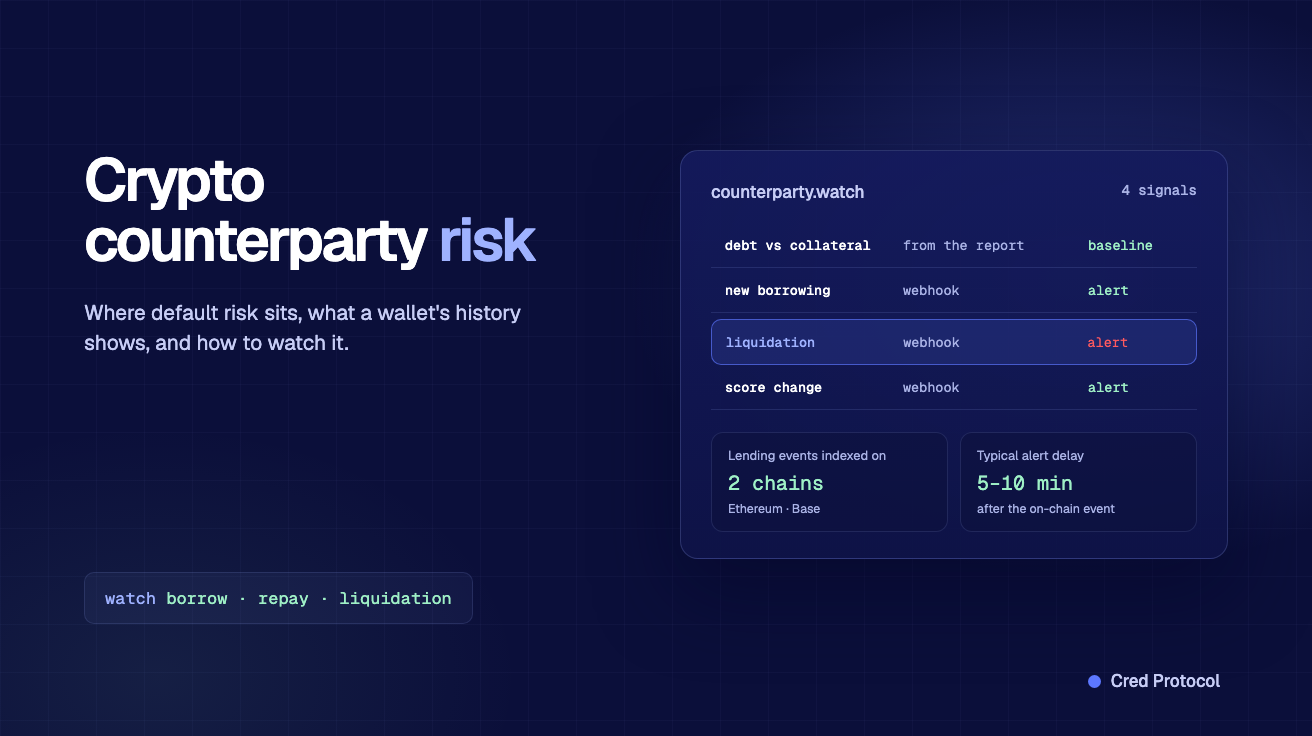
- Watch for the events that matter. Monitoring webhooks send a signed notification when a watched address borrows, repays or is liquidated, or when its credit score changes, typically within five to ten minutes of the on-chain event.
- Attach a response to each alert. A liquidation might mean no new credit until reviewed. A large new loan elsewhere might mean a call for more collateral. A score falling through a threshold might cut the limit at the next renewal. Write these down before the alert arrives.
- Take a new baseline on a schedule. Events tell you what changed. A fresh report tells you where the counterparty now stands.
The point of step four is time. Trouble at a borrower rarely starts with a missed payment to you. It starts with leverage rising or a liquidation somewhere else, and those are the events you can be told about while there is still something to do. Credit monitoring vs credit reporting explains how the pull and the push fit together.
If you run a lending protocol and the counterparties are your borrowers, the same steps apply at scale. Our DeFi risk management framework places them among the market-level controls.
What On-Chain Monitoring Cannot See
- Off-chain liabilities. Bank debt, loans from trading desks and balances on centralised exchanges do not appear on any chain. A counterparty can look unleveraged on-chain and be heavily indebted off it.
- Wallets you were not told about. You see the addresses you watch. Cred does not group addresses into entities, so borrowing from an undisclosed wallet is invisible to you.
- Protocols and chains outside coverage. Cred indexes lending events from Aave, Compound and Morpho Blue on Ethereum and Base, and reads wallet behaviour across ten EVM chains. Borrowing elsewhere is not in the history.
- A platform's solvency. Watching an exchange's known wallets shows assets moving. It does not show what the exchange owes its customers.
- Intent. A history describes what a wallet has done. It is evidence about the future, and it is not a guarantee of it.
These limits are the reason to treat on-chain monitoring as one input beside financial statements, legal agreements and collateral. It is not legal or investment advice, and Cred's default delivery is commercial analytics for assessing businesses and protocols, not a consumer report about an individual.
Next Steps
Pick one counterparty whose wallet you know, create an API key and pull its report. The webhooks guide shows how to register an address and verify the signature on each delivery, and the portfolio monitoring page describes the same approach across a book of borrowers.