

Two Kinds of Credit Scoring API
Search for a credit scoring API and you will find two different products under the same name.
The first is the bureau API. You send a person's name, date of birth and identity number, with their consent, and receive a score computed from their file at a credit bureau: cards, mortgages, missed payments. Access is contracted, regulated and usually sold through a sales process.
The second scores a wallet. You send a blockchain address and receive a score computed from what that address has done on-chain: what it borrowed, whether it repaid, whether it was liquidated, how long it has existed and what it holds. No personal data goes in, because none is needed. The history is public.
Cred Protocol is the second kind. If you need a score for a person with a bank account and no wallet, a bureau API is what you are looking for. If your borrowers, customers or counterparties arrive as addresses, read on.
| Bureau credit API | Wallet credit scoring API | |
|---|---|---|
| Subject | A person or company | A wallet address or ENS name |
| Input | Personal identifiers, with consent | The address |
| Data source | Lender-reported accounts | Public on-chain history |
| Coverage | People with a credit file in that country | Any address on supported chains |
| Getting access | Contract and onboarding | Self-serve API key, or pay per request |
The Request
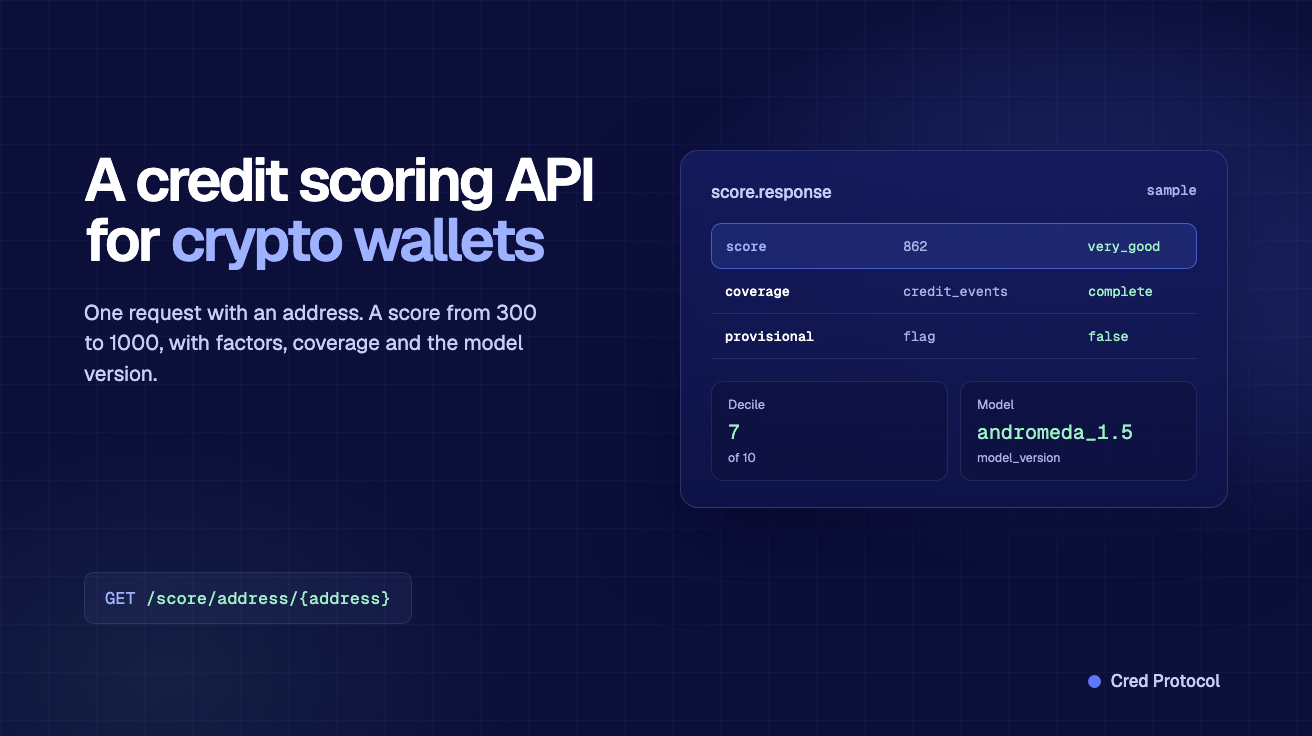
One GET request with the address or ENS name in the path:
curl https://api.credprotocol.com/api/v2/score/address/vitalik.eth \
  -H "Authorization: Bearer YOUR_API_KEY"
{
"address": "0xd8dA6BF26964aF9D7eEd9e03E53415D37aA96045",
"score": 862,
"decile": 7,
"range": "very_good",
"model_version": "andromeda_1.5",
"timestamp": "2026-11-23T10:30:00Z",
"credit_events_coverage": "complete",
"provisional": false,
"account_type": "eoa"
}The values above are a sample. The fields are the ones the API returns.
Reading the Response
The score and its range
The score runs from 300 to 1000, and higher is better. It falls into one of five ranges:
| Score | Range |
|---|---|
| 920 to 1000 | Excellent |
| 840 to 919 | Very good |
| 750 to 839 | Good |
| 640 to 749 | Fair |
| 300 to 639 | Low |
Factors
Add include_factors=true and the response explains itself. Each factor (Borrowing History, Wallet Composition, Wallet Health, Interactions, Trust and New Credit) comes with a rating and a plain-language description. Factors are rated, never quantified: the API does not expose weights or raw values, which keeps the score explainable without making it easy to game.
Coverage and the provisional flag
This is the field most integrations overlook. The first time an address is scored, its lending history is read from the chain. For most addresses that finishes inside the request. For an address with a long history it can take a few seconds more, and the response returns early with provisional: true.
A provisional score can be higher than the final one, because liquidations that have not been read yet are not counted. If you act on scores, check the flag and request again before acting. The API tells you what it has not read instead of presenting a partial answer as complete, and your integration should respect that.
Account type
account_type says whether the address is a wallet or a contract. A contract is scored like a wallet, so its score describes the contract's own history, not its owner's. If you only expect individual wallets, this is where you find out you have been sent a multisig or a token.
Model version
Every response names the model version that produced it. Store it with the score. When the model changes, the release notes say what changed, and you can tell which of your stored scores predate it.
What the Score Reads
Two kinds of data feed the model. Wallet behaviour (age, transactions, holdings, activity) is read across ten EVM chains. Borrowing history (every borrow, repayment and liquidation) is read from Aave, Compound and Morpho Blue on Ethereum and Base, where those events are indexed.
Liquidations older than seven years no longer affect the score, although they remain visible in the full report.
Beyond a Single Score
The score is the cheapest call and often the first. The same API key reaches the rest of the picture:
| Need | Endpoint | Cred Units |
|---|---|---|
| One score | Score | 1 |
| Many scores at once | Batch score | 1 per address |
| How a score has moved | Score history | 1 |
| The full file: balances, positions, loans, liquidations | Credit report | 7 |
| Money in and out over 30, 90 and 365 days | Cash flow | 8 |
| Sanctions screen | Screen | 1 |
If you are unsure whether you need the score, the report or ongoing alerts, credit monitoring API vs credit reporting API walks through the difference.
Three Ways to Pay
- An API key on a monthly plan with an allowance of Cred Units. Plans are on the pricing page.
- Per request, with no account, over x402 or the Machine Payments Protocol. The API answers an unpaid request with a 402 and its payment options, and the caller pays for exactly the call it makes. This is how AI agents use it. See the payments guide.
- Through MCP, where each endpoint is a tool an AI assistant or agent can call. See the MCP overview.
An Integration Checklist
- Build against the sandbox first. Sandbox endpoints return mock data in the production shape and cost nothing.
- Handle the provisional flag. Retry before acting on a provisional score.
- Handle "could not answer". If upstream chain data is unavailable, the API returns a 503 and does not charge, instead of scoring a wallet as though it had no history. Treat it as "try again", not as a low score.
- Cache sensibly. Scores are cached for five minutes on our side. Requesting the same address more often than that returns the same answer.
- Store the model version and timestamp with every score you keep.
- Know your delivery mode. The next section explains why.
What You May Use It For
By default, every response is delivered as commercial analytics. That covers risk analysis, portfolio and counterparty due diligence, pricing for businesses and protocols, fraud and sybil checks, and agent reputation. It is not a consumer report, and it must not be used to decide whether an individual gets credit, insurance, employment or housing.
Lending to individuals on the strength of their score is a different, certified delivery mode with its own obligations: a stated purpose on each request, ranked key factors for adverse-action notices, an inquiry record the wallet owner can see, and a dispute process. The delivery modes page explains both and how certification works.
Start Here
Create an API key, follow the quickstart, and score an address you know well. It is the fastest way to judge whether the output matches your own view of that wallet.