

The Short Answer
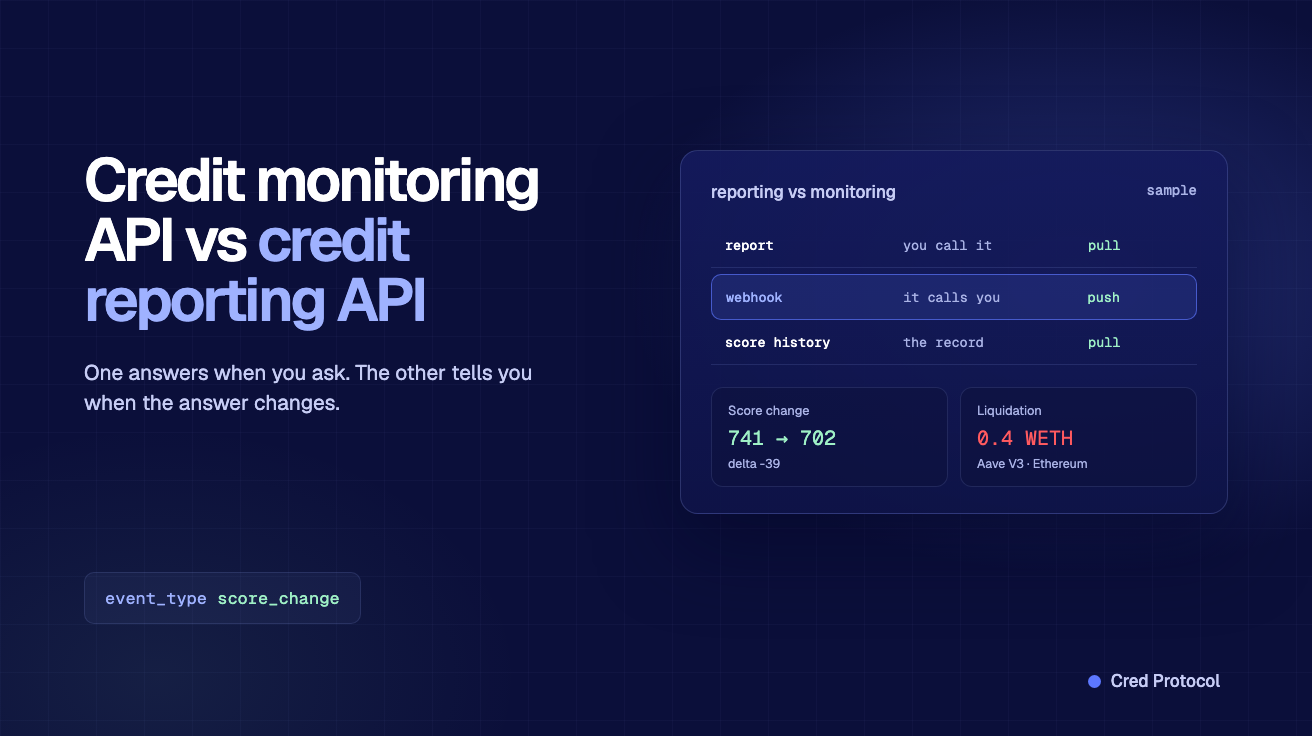
A credit reporting API is a pull. You ask about a borrower and receive their file as it stands at that moment: accounts, balances, payment history, a score.
A credit monitoring API is a push. You register the borrowers you care about once, and the service tells you when something in their file changes: a new loan, a missed payment, a score that moved.
Reporting is for making a decision. Monitoring is for finding out that a decision you already made needs another look. Most lenders need both, at different points in a loan's life.
| Credit reporting API | Credit monitoring API | |
|---|---|---|
| Direction | You call it | It calls you |
| Answers | "What does this borrower look like now?" | "What has changed since I last looked?" |
| Used at | Origination, renewal, periodic review | Every day in between |
| You pay for | Each report pulled | Each borrower watched, or each event delivered |
| You build | A request and a parser | A webhook endpoint and an event handler |
| Main risk | The answer goes stale the moment you store it | You only hear about the events you subscribed to |
When a Report Is the Right Tool
Pull a report when you are about to decide something and need the whole picture: whether to open a credit line, what limit to set, what rate to charge. A report is also the right tool for a scheduled review, where you re-underwrite a book of borrowers every quarter.
The limit of a report is time. It is accurate when it is generated and less accurate every day after. A lender who relies on reports alone finds out about a borrower's deterioration at the next scheduled pull, which may be months after it began.
When Monitoring Is the Right Tool
Monitor when you already have exposure and want to know the moment the risk changes. The events that matter are the ones that change what you would do: the borrower took on new debt elsewhere, the borrower was liquidated or defaulted elsewhere, the borrower's score crossed a threshold in your policy.
Monitoring does not replace the report. An alert tells you that something happened, and usually what. Deciding what to do about it often means pulling a fresh report to see the borrower's whole position.
The Polling Trap
Teams with a reporting API and no monitoring API often build monitoring themselves by pulling every borrower's report on a timer. It works at small scale and fails in two ways as the book grows.
Cost grows with the number of borrowers multiplied by how often you check, and almost every pull returns "nothing changed". And the delay is fixed by the timer: check daily and you learn about a liquidation up to a day late. Monitoring inverts both. You pay attention only when there is something to attend to, and you hear about it in minutes.
How This Works for Wallets
Everything above applies to bureau APIs, where the borrower is a person and the events are reported by lenders. It applies with one large difference when the borrower is a wallet: the events are public and available within minutes, with no reporting lag from a lender's monthly file.
Cred Protocol offers both halves for on-chain borrowers. It reads wallets, not bureau files, so it is the right tool when your borrowers or counterparties are addresses.
Reporting
The credit report returns a wallet's file across ten EVM chains: balances, lending positions, debt, and a credit-events section with every loan, repayment and liquidation found on Aave, Compound and Morpho Blue on Ethereum and Base, valued in dollars where a price is available. The score condenses it into a number from 300 to 1000. Both are single GET requests. The report says explicitly when part of a wallet's history could not be read, so a partial answer is never presented as a complete one.
Monitoring
Monitoring webhooks deliver signed notifications when a watched address acts. You choose the events:
- Lending events: borrow, repay, supply, withdraw and liquidation, decoded from the lending protocols' own events. These are the same events the score reads.
- Score events: a
score_changeevent when a watched address's score is recomputed and differs from the last one, carrying the previous score, the new one and the difference. - Wallet activity: transfers, approvals and native-currency transactions on every supported chain.
A liquidation notification looks like this, abridged:
{
  "event_type": "liquidation",
  "blockchain": "ethereum",
  "address": "0xab5801a7d398351b8be11c439e05c5b3259aec9b",
  "data": {
    "protocol": "aave_v3",
    "amount_raw": "2500000000",
    "collateral_amount_raw": "400000000000000000"
  }
}
Expect a delivery within roughly five to ten minutes of the on-chain event. Events are reported once they are a few blocks deep, so a chain reorganisation cannot retract a notification you have already acted on. Deliveries are signed, and failed ones are retried.
The history in between
There is a third piece that bureau APIs rarely expose cleanly: score history, the record of a wallet's score over time. It answers "how did we get here?" after an alert, without your having stored every score yourself.
Using Them Together
A typical lifecycle for a credit line to an on-chain borrower:
- At application, pull the score and the report. Screen the address against sanctions lists. Set terms.
- At origination, add the borrower's address to a webhook subscribed to liquidation, borrow and
score_change. - On an alert, pull a fresh report and apply your policy: do nothing, reduce the limit, or ask for more collateral.
- At renewal, pull the report again and read the score history for the period.
Steps one and four are reporting. Steps two and three are monitoring. Neither works well alone.
Questions to Ask Any Provider
- How fresh is a report? Ask how long results are cached and whether a report is computed on request.
- How late is an alert? Ask for the expected delay between an event and its delivery, and what happens if your endpoint is down.
- What is not covered? For on-chain data, ask which chains and which protocols are indexed for lending events. Cred indexes lending events on Ethereum and Base; wallet activity is covered on all ten chains.
- What happens when data is missing? A provider that returns an empty history when its upstream failed is worse than one that says it could not answer.
- What may the data be used for? Cred's default delivery is commercial analytics, not a consumer report. Credit decisions about individuals need the certified consumer-report mode.
Next Steps
The product pages for reporting and monitoring show sample output for each. To try both against a real address, create an API key, pull a report, and set up a webhook in the console.