

Why Almost Every Crypto Loan Is Over-Collateralized
Borrow on Aave, Compound or Morpho and you deposit more than you take out. To borrow $100 of a stablecoin you might lock $150 of ETH. If the collateral's value falls too far, the position is liquidated: the collateral is sold to repay the debt.
The design follows from one fact. A lending protocol knows nothing about its borrower except the address. It cannot take the borrower to court, report a default, or decline the next application. With no way to judge or pursue a borrower, the only safe loan is one that is fully covered by collateral the protocol already holds.
This works, and at scale. It also means the loans serve one purpose: getting liquidity or leverage from assets you already own. Someone who needs capital they do not have cannot get it this way.
What Exists With Less Collateral, or None
"Crypto loan without collateral" describes four different things. They are worth separating, because only some of them are loans in the usual sense.
Flash loans
A flash loan has no collateral and no credit check, and it must be repaid in the same transaction in which it was borrowed. If the repayment does not happen, the entire transaction is reversed as though the loan never occurred. Flash loans are a tool for arbitrage, refinancing and liquidations, used by developers and bots. They cannot fund anything that takes longer than a few seconds.
Institutional credit
Several on-chain lenders have extended uncollateralized or lightly collateralized loans to trading firms and other institutions. The borrower is a known company that passes KYC and KYB, signs a legal agreement and goes through a credit review. The loan is on-chain; the underwriting is traditional.
This market has a record worth knowing. Borrower defaults in 2022 hit it hard, and at least one of the largest lenders has since moved to lending mainly against collateral. Our comparison pages describe where each stands today, with sources.
Centralized lenders
Some companies offer crypto loans to individuals with identity verification and their own credit assessment. These are ordinary consumer loans that happen to be paid out in crypto, with the regulation that implies.
Credit based on on-chain history
The fourth kind is the newest: a protocol or lender offers better terms to borrowers whose wallets show a record of borrowing and repaying. In practice this usually starts as reduced collateral, 120% where others pay 150%, and moves toward less than 100% for the strongest borrowers.
This is the kind that can scale without a credit committee, because the underwriting input is data that already exists for every wallet. It is also the kind that depends entirely on how well the lender can read that data.
If You Are a Borrower
A direct answer, since this is what many people searching for the phrase want to know. There is no widely available product today where an anonymous wallet borrows a meaningful amount with no collateral. Be wary of anyone who says otherwise. An offer of an uncollateralized crypto loan that asks for an upfront fee or a "verification deposit" is a well-known scam pattern.
What does exist is a growing set of lenders who give better terms to wallets with a good record. Cred Protocol does not make loans. It supplies the credit data that lenders use, which means your wallet's history is what they see. The things that count are the ones you would expect: borrowing and repaying over time, avoiding liquidation, and keeping a wallet with real, sustained activity.
If You Are a Lender
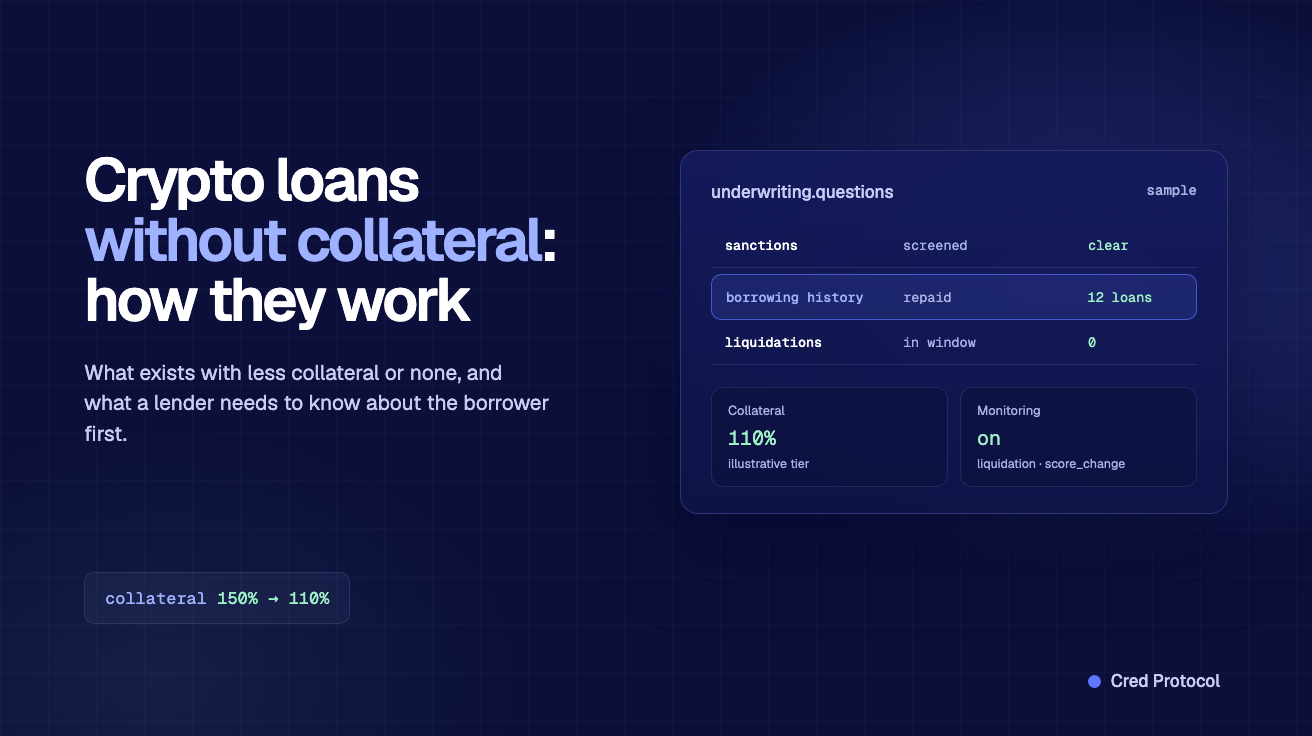
Lending with less collateral means replacing some of the collateral with knowledge of the borrower. Five questions cover most of what that knowledge needs to be.
1. Should we deal with this address at all?
Screen it against sanctions lists and check what it has transacted with before anything else. Our wallet screening guide covers the order to run those checks in.
2. Is this one borrower or one of a hundred?
Collateral makes identity irrelevant: a borrower with a thousand wallets has still posted collateral in each. Remove the collateral and a borrower who can create wallets freely can default freely. Any under-collateralized product needs sybil resistance, and a way to bind a borrower to a history they would be unwilling to abandon.
3. How has this wallet handled debt before?
A wallet's lending record is public: every borrow, repayment and liquidation on the major protocols. A credit score summarises it, and the credit report shows the detail behind it: loan by loan, with amounts in dollars and how each one ended.
4. Can it repay?
History shows willingness. Capacity is a separate question. What does the wallet hold, how much does it already owe, and what flows through it? A cash-flow view of money in and out over the past year is the on-chain equivalent of a bank statement.
5. What happens after we lend?
Without full collateral there is no automatic liquidation to protect you. You need to know quickly when a borrower's position changes: a new loan elsewhere, a liquidation elsewhere, a falling score. That is a monitoring problem, covered in credit monitoring vs credit reporting.
Starting Conservatively
A sensible path does not begin at zero collateral. It looks like this:
- Stay over-collateralized and vary the ratio. Offer a lower collateral requirement to borrowers with a strong record. Losses are still covered, and you learn how scores relate to behaviour in your own book. Our capital-efficient lending guide covers this stage.
- Cap exposure per borrower. Small limits first, raised as a borrower repays.
- Move below 100% for a narrow, well-understood segment, with monitoring in place and a clear policy for what triggers a reduced limit. See under-collateralized lending.
The illustrative policy below shows the shape. The thresholds are examples, not recommendations. Yours should come from your own loss data.
| Score range | Example collateral requirement |
|---|---|
| Excellent (920+) | 110% |
| Very good (840 to 919) | 125% |
| Good (750 to 839) | 140% |
| Fair and below | Standard terms |
The Regulatory Line
Who your borrowers are matters as much as how you score them. Lending to businesses, protocols, treasuries and agents using on-chain analytics is one thing. Deciding whether an individual gets credit is consumer lending, with consumer-protection obligations.
Cred's default delivery is commercial analytics and is not a consumer report. It is not to be used to determine an individual's eligibility for credit. Lenders who make credit decisions about individuals use the certified consumer-report delivery mode, which adds the pieces that kind of lending requires: key factors for adverse-action notices, an inquiry record, a seven-year limit on negative items, and a dispute process for the wallet's owner. Talk to us, and to your counsel, before building a consumer product.
Next Steps
If you are designing a lending product with reduced collateral, the fastest way to judge the data is to look up wallets you already know. Create an API key and pull a few reports, or book a demo and we will walk through your use case.