

Three Payment Rails, One Credit Score
When we launched MPP support last week, agents could pay for credit data using Tempo stablecoins directly or via our custom cred payment method. Today, we're announcing a third rail: Stripe crypto deposits settled on Tempo.
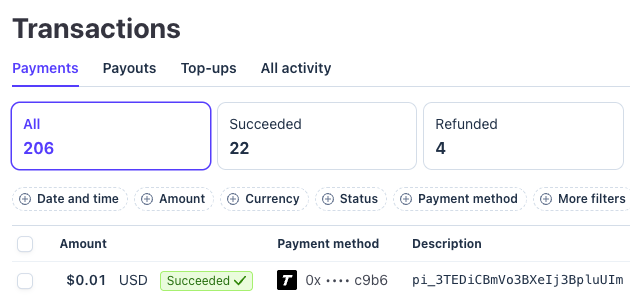
This means an agent can now pay for a Cred Protocol credit score by sending USDC to a Stripe-generated deposit address on the Tempo network. Stripe detects the on-chain transfer, confirms the PaymentIntent, and the score is delivered — all within about 60 seconds. No API keys. No accounts. No subscription.
It's the same $0.01 per credit score. The same 402 challenge-response flow. But with Stripe handling settlement, agents and their operators get Stripe's full infrastructure — dashboards, receipts, dispute resolution, tax reporting — for what is fundamentally a stablecoin micropayment.
How Stripe MPP Crypto Deposits Work
The flow builds on the Machine Payments Protocol challenge-response pattern. When an agent requests a credit score without credentials, the server responds with a 402 Payment Required and a set of payment challenges. One of those challenges is the stripe method, which includes a Tempo deposit address and a Stripe PaymentIntent ID.
- Agent requests data —
GET /api/v2/score/address/vitalik.eth - Server returns 402 with MPP challenges (Tempo, Stripe, Cred)
- Agent chooses Stripe and sends 0.01 USDC to the deposit address on Tempo
- Stripe detects the deposit and transitions the PaymentIntent from
requires_actiontosucceeded - Agent retries with credential containing the transaction hash and PaymentIntent ID
- Server verifies via Stripe API, confirms payment, and returns the credit score with a
Payment-Receiptheader
# Step 1: Request score (get 402 challenge with Stripe deposit address)
curl -i https://api.credprotocol.com/api/v2/score/address/vitalik.eth

# Step 2: Send USDC to the Stripe deposit address on Tempo
# depositAddress: 0x1b23e1017af23202a59d263ef7e9dfd4f5b619de

# Step 3: Build credential with tx hash and retry
curl -H "Authorization: Payment eyJ..." \
  https://api.credprotocol.com/api/v2/score/address/vitalik.eth

# Response: 200 OK
# Payment-Receipt: { "status": "success", "method": "stripe", "reference": "pi_3TED..." }
# Body: { "score": 772, "range": "good", "address": "0xd8dA..." }
The key detail: Stripe's crypto deposit flow creates a unique deposit address per PaymentIntent. The agent sends USDC to that address on Tempo, and Stripe auto-captures when the funds settle on-chain. From Stripe's perspective, it's a standard PaymentIntent lifecycle — just with a crypto payment method instead of a card.
Comparing the Three Payment Paths
Cred Protocol now supports three distinct ways for agents to pay for credit data via the 402 pattern. Each serves a different set of constraints.
| Dimension | Direct Tempo (MPP) | Stripe Crypto Deposit (MPP) | x402 (Coinbase CDP) |
|---|---|---|---|
| Protocol | MPP | MPP | x402 |
| Settlement chain | Tempo | Tempo (via Stripe) | Base, SKALE |
| Payment method | Direct USDC transfer | USDC to Stripe deposit address | Signed USDC authorization |
| Settlement time | ~2 seconds | ~30-60 seconds | ~5-15 seconds |
| Merchant infrastructure | None required | Stripe dashboard, receipts, reporting | Facilitator (Coinbase CDP) |
| Compliance tooling | Minimal | Full Stripe stack (tax, fraud, disputes) | Developer-managed |
| Agent complexity | Low — direct transfer | Medium — deposit + retry | Low — sign + send |
| Best for | Crypto-native agents, speed | Enterprise agents, auditability | Permissionless, multi-chain |
Direct Tempo: Fastest and Simplest
The direct tempo payment method is the most straightforward path. The agent reads the challenge, sends USDC to the recipient address on Tempo, and provides the transaction hash as proof. Settlement is near-instant — Tempo's sub-second finality means the transaction is confirmed before the agent's next retry. There's no intermediary, no deposit address indirection, and no waiting for a third party to detect the payment.
This is the right choice for crypto-native agents that already hold USDC on Tempo and prioritize speed. The tradeoff: the merchant (Cred Protocol) handles settlement directly, without Stripe's reporting and compliance infrastructure.
Stripe Crypto Deposit: Enterprise-Grade Settlement
The Stripe path adds a layer of infrastructure between the agent's payment and the merchant's receipt. Instead of sending USDC directly to Cred Protocol, the agent sends it to a Stripe-controlled deposit address. Stripe monitors the Tempo network for incoming deposits, matches them to PaymentIntents, and settles — giving both the agent operator and the merchant a full audit trail in the Stripe dashboard.
The tradeoff is latency. Stripe needs to detect and confirm the on-chain deposit before transitioning the PaymentIntent to succeeded. In our testing, this takes 30-60 seconds — fast enough for most agent workflows, but noticeably slower than direct Tempo transfers.
The payoff: every payment shows up in the Stripe dashboard as a standard transaction. Operators managing fleets of agents get the same reporting, reconciliation, and dispute tools they use for all their other Stripe payments. For enterprises running agents in production, this auditability isn't optional — it's a requirement.
x402: Permissionless and Multi-Chain
x402 remains the most permissionless option. Any agent with a wallet and USDC on Base or SKALE can pay for credit data without touching Tempo or Stripe. The x402 protocol coordinates payment through a facilitator (Coinbase CDP), and the entire flow — from payment authorization to data delivery — completes in a single HTTP round-trip.
x402's strength is its independence: no vendor lock-in, no specific chain requirement (beyond what the API provider supports), and no intermediary beyond the facilitator. It's also the most mature path — we've been running x402 in production since February, and it handles the majority of our autonomous payment volume today.
Why All Three Matter
Supporting multiple payment rails isn't about hedging bets — it's about meeting agents where they are. The machine economy isn't a monoculture. Agents operate in different environments with different constraints:
- A DeFi liquidation bot holds USDC on Base and needs sub-second credit checks. x402 is the obvious choice — minimal latency, no chain-switching required
- An enterprise compliance agent runs in a regulated environment where every transaction needs a paper trail. Stripe crypto deposits give it MPP's flexibility with Stripe's auditability
- A Tempo-native agent orchestrating workflows across MPP-enabled services already holds stablecoins on Tempo. Direct Tempo payment is the fastest path with zero overhead
- A high-reputation agent with a Cred Score above 640 can skip payment entirely and access data on credit via the
credmethod
The pattern is clear: as machine payments mature, agents will choose payment rails the same way businesses choose payment methods today — based on cost, speed, compliance requirements, and existing infrastructure. The services that support the widest range of options will capture the most agent traffic.
Stripe's Expanding Role in Machine Payments
This is the second time in a week that Stripe has deepened its involvement in machine-to-machine payments. Earlier this month, Stripe added x402 support on the merchant side — letting API providers receive x402 payments through Stripe's PaymentIntent infrastructure. Now, with MPP crypto deposits on Tempo, Stripe is also processing payments on the MPP side.
Stripe is positioning itself as the settlement layer for the machine economy, regardless of which protocol the agent uses. Whether an agent pays via x402 or MPP, Stripe can be the infrastructure that processes, reports on, and reconciles the transaction. For API providers, this means a single dashboard for all machine payment revenue — whether it arrives as an x402 payment on Base or an MPP crypto deposit on Tempo.
For the machine payments ecosystem, this convergence is healthy. Competition between x402 and MPP pushes both protocols forward. But on the merchant side, Stripe is emerging as the common denominator — the infrastructure that works with both.
Getting Started
All three payment methods are live on every Cred Protocol scoring, reporting, and identity endpoint:
- Stripe MPP (new): Send USDC to the Stripe deposit address returned in the MPP challenge. Stripe settles on Tempo and confirms via PaymentIntent
- Direct Tempo: Send USDC directly to the recipient address on Tempo. Near-instant settlement
- x402: Sign a USDC payment authorization via Coinbase CDP. Settles on Base or SKALE
No matter which rail you choose, the price is the same ($0.01 per credit score), the data is the same, and no account or API key is required.
Read the integration docs to get started, or explore the MPP specification and x402 protocol for the full technical details.