

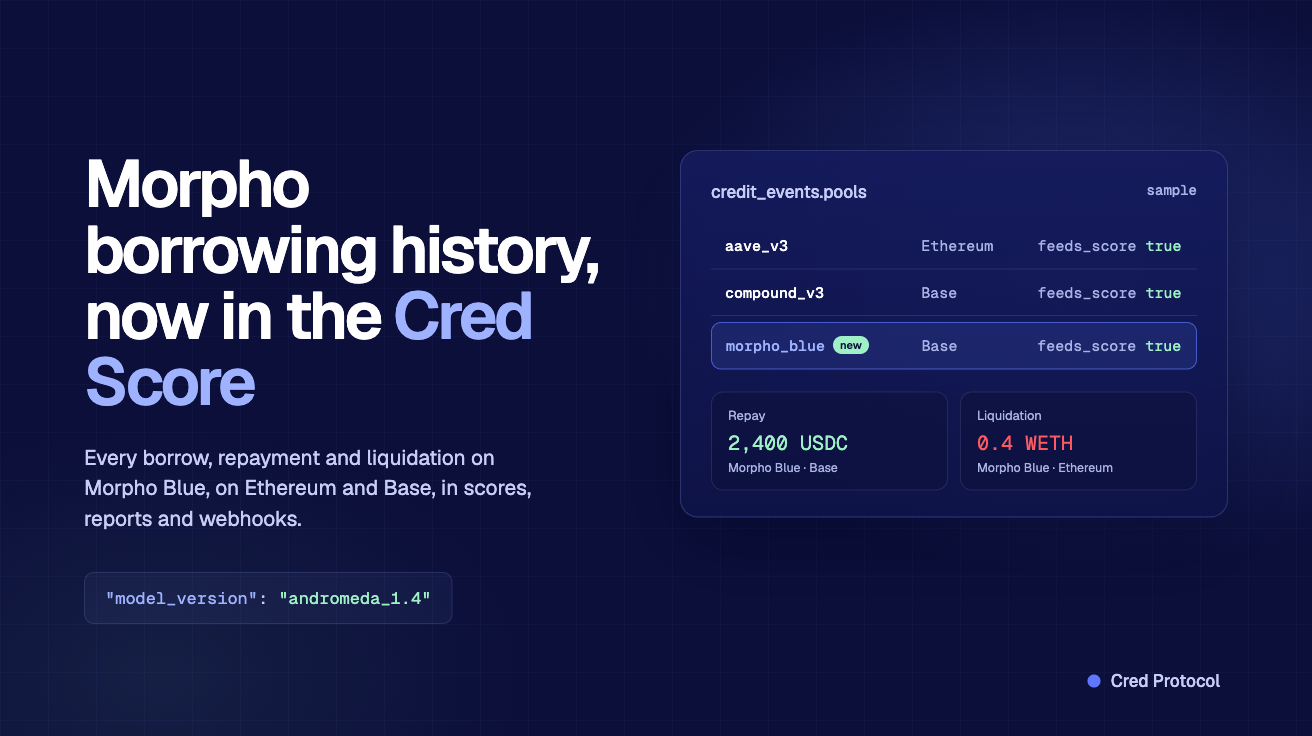
A Credit History With a Gap in It
A credit score is only as complete as the record behind it. When we added repayment and liquidation history to the Cred Score, we started where most onchain borrowing has happened: Aave, then Compound. That covered a large share of the market, but not all of it, and the part it missed has been growing fastest.
Morpho Blue is a lending protocol built differently from the pools that came before it. Instead of one shared pool per asset, anyone can open an isolated market: one asset to lend, one to post as collateral, an oracle and a liquidation threshold, fixed for life. That design has made Morpho the venue behind a lot of new credit products, including Coinbase's crypto-backed loans on Base. A borrower who has spent the last year repaying loans on Morpho had, until today, the same Cred borrowing history as someone who had never borrowed at all.
That gap is now closed. As of Andromeda 1.4, every borrow, repayment and liquidation on Morpho Blue, on Ethereum and Base, counts towards the Cred Score in the same way as Aave and Compound. Reports show Morpho positions alongside everything else a wallet holds and owes, and monitoring webhooks fire on Morpho events.
What Changes in the Score
Andromeda 1.4 does not change the model's weights or its 300 to 1000 range. It adds Morpho's events to the inputs the model already reads:
- Repayments and liquidations on Morpho feed the Borrowing History and Wallet Health factors, exactly as Aave and Compound events do. A liquidation on Morpho lowers a score the way one on Aave would.
- New borrowing on Morpho counts towards New Credit, which looks at how many loans a wallet has opened in the last 90 days and how quickly that is accelerating. A sudden burst of new loans reads as credit-seeking, wherever it happens.
- Wallets with no Morpho history are scored exactly as before.
The effect is largest for wallets whose borrowing lives mostly or entirely on Morpho. A wallet that had repaid Morpho loans but never borrowed on Aave or Compound used to read as having no credit history at all, and the score held it down accordingly. It now has a record, and the score reflects it. A wallet liquidated on Morpho, which used to look clean, now does not.
Responses report model_version: "andromeda_1.4", and the model release notes describe the change.
Reading Morpho Is Different
Morpho Blue is a single contract per chain that holds every market. Its events name a market by an identifier, not by the tokens involved, and its positions are not tokens a wallet holds: debt, collateral and lender deposits all sit inside the contract. Neither of the shortcuts that work for Aave applies.
Borrowing history
We read a wallet's own Morpho events directly from the chain: supplies and withdrawals (of collateral and of lent assets), borrows, repayments and liquidations, and resolve each market to its loan and collateral tokens. Only events where the wallet is the owner of the position count. A wallet that merely sent a repayment on someone else's behalf, or received funds from someone else's loan, does not inherit that history.
In a report, Morpho appears in credit_events.pools as one entry per chain, next to Aave and Compound:
{
  "protocol": "morpho_blue",
  "chain_id": 8453,
  "market": null,
  "feeds_score": true,
  "coverage": "complete",
  "counts": { "supply": 80, "withdraw": 6, "borrow": 89, "repay": 17, "liquidation": 6 },
  "first_event_at": "2024-12-15T09:37:31+00:00",
  "last_event_at": "2026-10-30T21:32:39+00:00"
}
Open positions
For every market a wallet has used, we read its position from the Morpho contract itself and convert it into amounts of the loan and collateral tokens. Open Morpho debt now counts in total_debt_usd and as an active loan, and Morpho collateral in total_collateral_usd, so the loan-to-value ratio in a report includes Morpho. Balance History reads the same positions as they stood 30, 60 and 90 days ago.
How We Checked It
Every protocol we add runs in shadow first: its events appear in reports, marked feeds_score: false, while we confirm on real wallets that what we read is what happened. Morpho went through the same steps.
- Events. For wallets with known liquidations on both chains, the counts we stored for every event type matched an independent query of the chain, event by event.
- Positions. For large live borrowers, the collateral we read matched Morpho's own figures to the last unit, and debt agreed to within a few hundredths of a percent.
- Production. In shadow, every Morpho sync in production completed within the time a report allows.
Webhooks Too
If you watch wallets with our monitoring webhooks, Morpho events are already part of the lending feed: a liquidation, borrow, repay, supply or withdraw on Morpho Blue reaches your endpoint the same way an Aave or Compound event does, typically 5 to 10 minutes after the block. A borrower you funded being liquidated on Morpho is exactly the kind of thing you want to hear about from us rather than from them. The webhooks guide covers setup.
One Correction in the Same Release
While adding Morpho debt, we found that a report's net_worth_usd was not subtracting debt: debt was being counted as part of a wallet's assets and then taken away once, so net worth came out equal to total assets. It now means what the documentation always said, assets minus debt, and total_asset_usd no longer includes what a wallet owes. Net worth feeds the Wallet Health factor, so scores for wallets carrying debt on any protocol came down slightly. Wallets without debt are unaffected.
What It Does Not Cover Yet
- Other chains. Morpho runs on more chains than Ethereum and Base. Borrowing history is read on the two chains where we index lending events today.
- Vault deposits. Depositing into a Morpho vault is lending, not borrowing, so it does not add borrowing history.
- Morpho's earlier products. The Morpho Optimizers that ran on top of Aave and Compound are separate contracts and are not included.
- Interest since the last update. Debt is read as of the market's last activity. On busy markets that is seconds old; on quiet ones it can trail by a few days of interest.
Try It
Nothing changes in how you call the API or what it costs. Request a score or a report for any address with Morpho history and the new data is there:
curl https://api.credprotocol.com/api/v2/score/address/0xYourBorrower?include_factors=true -H "Authorization: Bearer YOUR_API_KEY"The chains and protocols page lists exactly what is read on each chain. If you do not have an API key yet, create one in the console; the sandbox already returns Morpho pools in its mock reports.